Trump's Shifting Stance on Ukraine: A Fractured Alliance and Global Repercussions
Trump's shifting stance on Ukraine—marked by tensions with Zelenskyy and a potential aid freeze—is shaking global alliances and putting Ukraine's defense at risk.

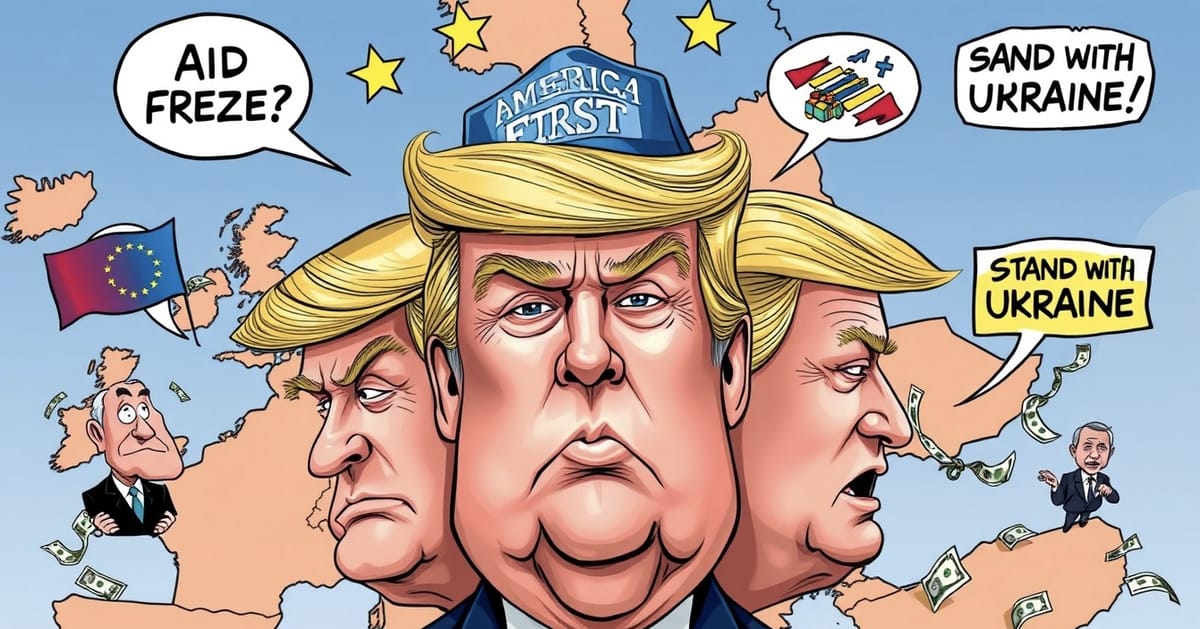
The international stage finds itself in a precarious state as former President Donald Trump's evolving views on the Ukraine conflict send ripples of uncertainty throughout Europe and beyond. Recent reports of a tense exchange with Ukrainian President Zelenskyy, coupled with the real possibility of a U.S. aid freeze, have prompted European leaders to reassess their strategies. They now face the unsettling prospect of a future where U.S. financial support is no longer guaranteed. This article delves into Trump's position, its potential impact on Ukraine, and the broader implications for a global order already facing considerable strain.
Trump's Contentious Relationship with Zelenskyy and the Threat of an Aid Freeze
Predictability has rarely been a hallmark of Trump's political style, and his approach to the Ukraine conflict is no different. Recent reports indicate a growing strain in his relationship with Ukrainian President Volodymyr Zelenskyy, allegedly culminating in a heated exchange (CNN). While details remain scarce, the tension is palpable. Trump's longstanding skepticism regarding U.S. involvement in foreign conflicts, combined with his "America First" policy, casts a shadow of doubt over the future of U.S.-Ukraine relations. Newsweek reports Trump considered halting U.S. military aid to Ukraine (Newsweek). Is this a calculated negotiating tactic, reminiscent of his "Art of the Deal" approach? Or does it represent a genuine shift in policy that could leave Ukraine vulnerable?
A U.S. aid cutoff would have severe consequences for Ukraine's war effort. Deprived of crucial financial and military assistance from Washington, Kyiv could face significant territorial losses and a weakened position in any future negotiations. Some analysts even suggest that Ukraine's ability to sustain its defense is critically dependent on continued Western support (CSIS). However, the situation is not without potential alternatives. A more unified and committed Europe could potentially step in to fill the gap left by the U.S. withdrawal, provided that internal divisions and conflicting priorities can be overcome.
Europe's Response: A Quest for Unity and Increased Responsibility
Faced with the potential for a U.S. retreat, European leaders are actively seeking ways to bolster their support for Ukraine. Zelenskyy's recent tour of London and planned appearances at a European summit (ABC News) highlight the urgency of securing European backing. The UK Prime Minister has proposed a "peace deal framework" (Fox News), although Zelenskyy's cautious response suggests that significant challenges remain in reaching a consensus. The critical question is whether Europe can overcome its internal divisions and unite behind a common strategy to support Ukraine, or whether national interests will continue to impede collective action.
The primary challenge for Europe is not necessarily financial resources, but rather political will and coordination. While some nations, particularly those bordering Russia, are strong advocates for supporting Ukraine, others are more hesitant, influenced by economic considerations and a desire for a swift resolution to the conflict, even if it involves compromises. The controversy surrounding Peter Mandelson's remarks regarding Ukraine, which required immediate clarification from the government (The Guardian), underscores the delicate political landscape. The crucial question is whether Europe can forge a unified and effective response, or whether it will remain fragmented by competing interests and priorities.
Geopolitical Implications: Russia's Perspective and the China Factor
Trump's potential policy shift has been met with apparent approval in Moscow. Politico.eu reports that Russia views the alignment of U.S. foreign policy with its own interests as a positive development (Politico.eu). A weakened Ukraine, lacking Western support, could embolden Russia to escalate the conflict and pursue its territorial objectives. This raises the question of whether the U.S. is relinquishing its role as a global leader, potentially creating a power vacuum that other nations may seek to fill.
China's role in this geopolitical landscape is complex and uncertain. Some analysts suggest that stable relations between China and Russia could contribute to a peaceful resolution in Ukraine (South China Morning Post). However, others argue that China's primary focus is on its own self-interest. While China is unlikely to jeopardize its relationship with Russia, it also relies on access to Western markets. The key question is not whether China is capable of playing a constructive role, but whether it is willing to do so, and what conditions it might attach to its involvement.
Domestic Political Ramifications: Patriotism, Tariffs, and the Political Landscape
The Ukraine issue has become a contentious political issue within the United States. Some Democrats are attempting to reclaim the narrative of "patriotism" (Politico) in an effort to appeal to disillusioned voters. Meanwhile, Trump's focus on tariffs, including those targeting Canada and Mexico (The Guardian), could disrupt the economy and alienate key voting groups. The extent to which these political strategies will resonate with voters remains to be seen, but they are likely to further exacerbate existing partisan divisions.
The political climate is further complicated by figures like Andrew Cuomo, who is reportedly launching a mayoral campaign (NBC News). Furthermore, expressions of anti-Trump sentiment at events like the Oscars (India Herald) reflect the deep political divisions within the country. The aggressive and often theatrical style of politics seen in countries like India (Times of India) serves as a reminder that polarized discourse is a global phenomenon. Finally, the growing prominence of Black, queer, and trans women in politics (GLAAD) is essential for building a more inclusive and representative democracy, one that ideally will not abandon Ukraine in its time of need.
Conclusion: An Uncertain Future for Ukraine and Global Alliances
The situation surrounding Trump's stance on Ukraine is complex and fraught with uncertainty. His strained relationship with Zelenskyy, the potential for a U.S. aid cutoff, and the broader geopolitical implications create a concerning outlook. Europe is being challenged to address its own shortcomings, while Russia and China are closely monitoring the situation. The domestic political landscape in the U.S. further complicates matters. The future of Ukraine, and the stability of the global order, will depend on the decisions made in the coming months. Whether the West will maintain a united front, or whether the conflict will escalate into a protracted and devastating stalemate, remains to be seen. The situation demands careful attention and a commitment to finding a peaceful and sustainable resolution.