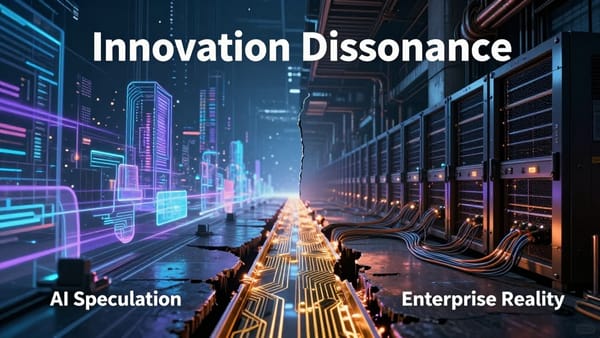
The Dual Face of Innovation: Navigating the Friction Between Generative AI and Human Craft

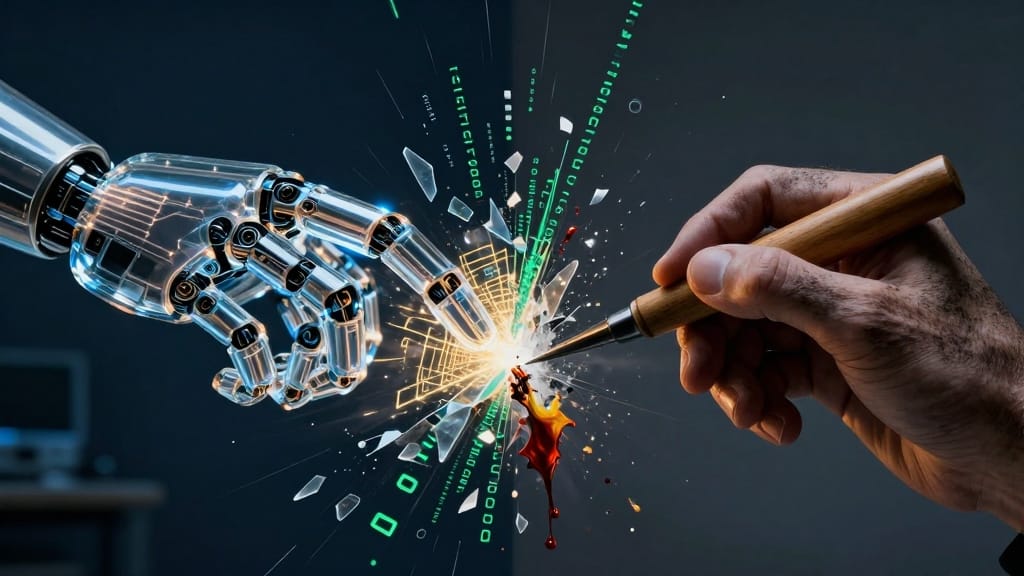
The dawn of 2026 has brought a stark realization to the technology sector: the "honeymoon phase" of artificial intelligence has transitioned into a complex era of market volatility and cultural pushback. As software stocks face unprecedented turbulence and creators grapple with the automation of their crafts, a clear divide is emerging between those who prioritize rapid AI integration and those who advocate for "human-centric" innovation. This tension is not merely philosophical; it is manifesting in multi-billion dollar capital expenditures, a radical restructuring of the software-as-a-service (SaaS) market, and a grassroots movement to preserve the integrity of open-source development. We are no longer debating whether AI will be integrated into our workflows, but rather how much of the human element we are willing to sacrifice for the sake of efficiency and whether the economic math of this transition actually holds up under scrutiny.
This report analyzes the current state of technology as it stands at this crossroads. We will explore how major players like Microsoft and Google are reshaping their ecosystems, why the investment community is suddenly wary of once-stable software giants, and how the hardware world is responding through both high-end mobile releases and community-driven modding projects. From the fiscal realities of data center construction to the subtle nuances of "lo-fi" focus tools, the narrative of 2026 is one of recalibration—where the goal is no longer just to build more technology, but to determine what role technology should play in our professional and creative lives. The analytical lens of history suggests that every major technological leap undergoes a period of "creative destruction"; however, the speed of the current AI cycle is testing the limits of institutional and individual adaptability.
The Market Paradox: AI Infrastructure vs. SaaS Survival
In the financial markets, a curious and somewhat alarming divergence is occurring between companies that provide the "picks and shovels" of AI and those that build software on top of it. This isn't just a minor correction; it's a fundamental re-evaluation of the Software-as-a-Service (SaaS) model that has dominated Silicon Valley for fifteen years. According to Bloomberg, the new year has seen software stocks sink on the "fear of new AI tools," marking the worst start for the group in several years. The core of this anxiety lies in the "per-seat" licensing model. If an AI agent can perform the work of five junior developers or ten customer service agents, the enterprise customer needs fewer seats, and the SaaS provider’s revenue collapses, regardless of how much AI they integrate into their platform.
A prime example of this struggle is GitLab (GTLB). As reported by The Motley Fool, the DevSecOps platform’s stock has fallen roughly 45% over the past year as investors worry that AI will lead to fewer human coders. The logic is clinical: if GitLab's value is tied to the number of developers using its repository and security tools, a world with fewer developers is a world with a smaller GitLab. However, this may be a short-sighted view. While the number of humans might decrease, the volume of code produced by AI and the need to secure it will likely explode, creating a "volume-based" opportunity that the market has yet to price in correctly. The transition from "selling to humans" to "governing AI agents" is the most significant pivot these companies will ever make.
Contrast this with the "hyperscalers." When comparing infrastructure giants, The Motley Fool highlights that Microsoft remains a formidable OpenAI partner, generating a massive $25 billion in free cash flow in its most recent quarter. This capital is being poured back into the earth—quite literally—through the construction of massive AI data centers. Microsoft and Oracle are engaging in a capital expenditure arms race that favors the incumbent with the deepest pockets. For these giants, the "SaaS turmoil" is secondary to the "Compute Era." They are betting that even if individual software companies suffer, the demand for the underlying compute power required to run AI models will continue to grow exponentially. We are seeing a consolidation of power where the hardware and energy required to run AI become the ultimate gatekeepers of the digital economy.
Data Integrity and the "OpenSlopware" Backlash
As AI-generated content and code saturate the internet, we are witnessing the emergence of "Model Collapse"—a theoretical state where AI models trained on AI-generated data begin to degrade in quality. In response, a counter-movement is rising among developers who prize transparency and manual craftsmanship. A collaborative project known as "OpenSlopware" has surfaced on the European Codeberg git forge. According to The Register, this repository documents free and open-source software (FOSS) projects that have been "contaminated" by LLM-bot generated code or coding assistants. This reflects a growing concern that the unvetted use of AI in software development could lead to insidious technical debt, subtle logic errors, and a general "graying" of the software landscape where nothing is broken, but nothing is truly innovative.
This backlash isn't limited to the world of bits; it has crossed over into the world of high fashion and luxury goods. At the Prada A/W 2026 menswear show, the message was one of intentional traditionalism. As reported by Wallpaper*, the luxury brand emphasized that "technology cannot replace the ability to work with your hands." This is a significant cultural marker. Just as the Industrial Revolution eventually birthed the "Handmade" and "Artisanal" movements as a luxury tier, the AI revolution is creating a premium for "Human-Made" intellectual and creative output. In an era where a child can generate a digital masterpiece with a prompt, the value shifts back to the physical, the tangible, and the demonstrably difficult.
The music industry is perhaps the most embattled front in this war for integrity. However, history provides a roadmap. According to Fast Company, the solution to AI in music may not be suppression, but rather better data management and attribution. They draw a parallel to the 2009 controversy over auto-tune—a technology that was once decried as the "death of the singer" but eventually became a standard creative tool. The challenge for 2026 is creating a "digital provenance" system. If we can track the lineage of a piece of code or a melody back to its human or synthetic origin, we can maintain a fair marketplace. The "OpenSlopware" movement is essentially the first iteration of this auditing process, a grassroots attempt to label the ingredients of our digital world before we lose track of what is authentic.
Hardware Innovation: From Modding to Refurbished Flagships
While software debates about "slop" and "contamination" rage, the hardware sector is dealing with a much more practical problem: the "Flagship Fatigue" caused by soaring prices and diminishing returns in yearly upgrades. Samsung is leaning into this reality by pivoting toward sustainability as a core business strategy. According to Forbes, the tech giant has confirmed that the Galaxy S25 Ultra will be available through more Certified Re-newed stores. This is a brilliant strategic move. By treating refurbished devices as a first-class product line, Samsung effectively creates a "ladder" for consumers: those who want the absolute peak of AI hardware can buy the S26 Ultra, while price-conscious users can get the S25 Ultra at a discount without the risks associated with third-party marketplaces. It acknowledges that the hardware has reached a level of "maturity" where a year-old flagship is still more than sufficient for 95% of users.
On the enthusiast side of the spectrum, the spirit of "hardware hacking" is enjoying a renaissance as a form of resistance against the walled gardens of major tech consoles. As reported by VideoCardz.com, a modder has created the "Ningtendo PXBOX 5," a 3-in-1 combo console that integrates a PS5, Xbox Series S, and Switch 2 into a single unit. While clearly a niche project, it highlights a profound user desire for interoperability. In a world where hardware manufacturers try to lock users into proprietary ecosystems (often to harvest data for их own AI models), the modders are showing that the "end of the console wars" might come through hardware ingenuity rather than corporate cooperation. It is a reminder that the user, not the manufacturer, should ultimately control the device they purchased.
This hardware maturity also affects the "Pro" market. We are seeing a shift away from "more power" toward "more utility." The integration of AI chips (NPUs) into every mobile device has become standard, but the real innovation is in power efficiency and thermal management. The Galaxy S25 Ultra and its peers are no longer just phones; they are localized AI nodes. The push toward refurbished models suggests that the hardware "specs race" is cooling down, replaced by a "software-features" race. For the consumer, this means the value of their device is increasingly determined by the longevity of its software support—something Samsung and Google have both pushed to seven years—rather than just the speed of its processor.
Consumer Security and the Psychology of "Low-Fi"
In the consumer software space, the promise of AI-driven convenience is being weighed against the increasing complexity of digital security. Google recently made a major decision regarding Gmail that has sent ripples through the tech community. According to Forbes, shifts in how Google handles secondary accounts and verification suggests that users may need to rethink their email strategies to maintain privacy. The era of having a single "catch-all" email address that connects to every digital service is becoming a security liability. As AI makes phishing attacks more sophisticated and "deepfake" audio makes two-factor authentication via voice obsolete, the humble email address remains a primary point of failure. This is forcing a return to "security hygiene" that many consumers had ignored for years.
Parallel to these security concerns is a growing psychological fatigue known as "digital overwhelm." The more our devices try to "help" us with notifications and AI suggestions, the less we seem to accomplish. This has created a massive market for "low-fidelity" or "lo-fi" focus tools. TechRadar recently profiled Lola, a music solution designed specifically to be "un-distracting." Lola doesn't use complex algorithms to suggest the next hit; it provides a consistent, low-fidelity sonic environment that allows the human brain to enter a flow state. It is a "secret weapon" for productivity precisely because it does less, not more. This represents a broader shift: the most valuable technology in 2026 might be the technology that knows when to turn itself off or get out of the way.
Even our leisure time is reflecting this desire for analog-adjacent experiences. Despite the rise of VR and immersive gaming, the enduring popularity of digital puzzles remains unshakable. Users continue to flock to the New York Times’ offerings, seeking human-crafted challenges. As evidenced by the consistent demand for help with Wordle and the domino-matching game Pips, there is a fundamental human satisfaction in solving a discrete, well-designed problem that hasn't changed in decades. These games offer a "safe space" from the infinite scroll and the algorithmic feed—a place where the rules are fixed and the goal is simple. This "purity" is why we see high engagement for simple word and logic games even as high-end graphics and generative AI attempt to redefine "fun."
Societal Impacts: Legal Precedents and Environmental Realities
Technology's influence has moved beyond the screen and into the very pillars of our legal and physical worlds. In a significant discussion at the Jaipur Literature Festival, former Chief Justice of India D.Y. Chandrachud addressed the complexities of national security and judicial detention. He specifically referred to the Umar Khalid case to illustrate a broader point about the modern justice system. As reported by Zee News, Justice Chandrachud emphasized that "jail before verdict cannot be punishment." In the context of 2026, where digital surveillance and algorithmic risk assessments are increasingly used by law enforcement, these judicial reminders of human rights and due process are more critical than ever. We are seeing a "tug-of-war" between the efficiency of automated legal systems and the nuanced, slow, but necessary "friction" of human justice.
The physical world also served a reminder of tech's role in disaster management. According to Zee News, a 5.7 magnitude earthquake recently struck the Leh-Ladakh region. In these moments, the "high-tech" infrastructure of satellites and 5G becomes a lifeline. The ability to monitor structural damage and track casualties in real-time has improved significantly, yet the event also highlights the vulnerability of our digital grid. When the earth moves, the cloud is only as good as the physical cables and towers that support it. This puts a spotlight on the importance of "resilient tech"—systems that can operate in degraded states—as the climate and seismic activity continue to challenge our global stability.
Finally, for the individual worker trying to navigate this chaotic landscape, the focus has shifted entirely to "adaptability." The fear of being replaced by AI is being met with a massive push for education. ZDNET highlights that free AI courses and certificates are no longer just for software engineers; they are becoming essential for marketers, designers, and project managers. The goal of "upskilling" in 2026 isn't to become a prompt engineer—a role that is already being automated—but to understand how to audit and direct AI tools. The successful professional of 2026 is one who maintains their "human craft" (the ability to think critically and creatively) while using AI as a high-speed research assistant. It is a return to the "liberal arts" approach to technology: knowing enough about everything to ensure the machines are headed in the right direction.
Conclusion: The Path Forward
The technological landscape of 2026 is defined by a necessary, and perhaps healthy, friction. We have moved past the wide-eyed optimism of the early 2020s and into a period of sober assessment. The financial dominance of Microsoft and the ubiquity of Google's ecosystem provide the world with the power to process information at an incredible scale, yet the "OpenSlopware" movement and Prada's emphasis on handiwork remind us that processing is not the same as creating. The future of the software market, and specifically companies like GitLab, will depend on their ability to transition from being simple "warehouses for code" to "verification engines for quality."
For the consumer, the path forward is one of intentionality. Whether it is choosing a "Certified Re-newed" S25 Ultra to reduce environmental impact and cost, or using Lola to carve out a space of focus in a noisy world, the power is shifting back to the user's choice. We must recognize that AI is an "extremist" technology—it will optimize for whatever we tell it to, regardless of the human cost. Therefore, the "Tech Observer’s" verdict for 2026 is clear: the most successful innovations will be those that acknowledge the friction between the digital and the physical, offering advanced capabilities while maintaining a clear, human-centered focus. The goal is not to defeat AI, but to ensure that in our rush to automate the mundane, we do not accidentally automate the meaningful.