The Convergence of Compute, Sustainability, and Infrastructure: A 2025 Tech Industry Analysis

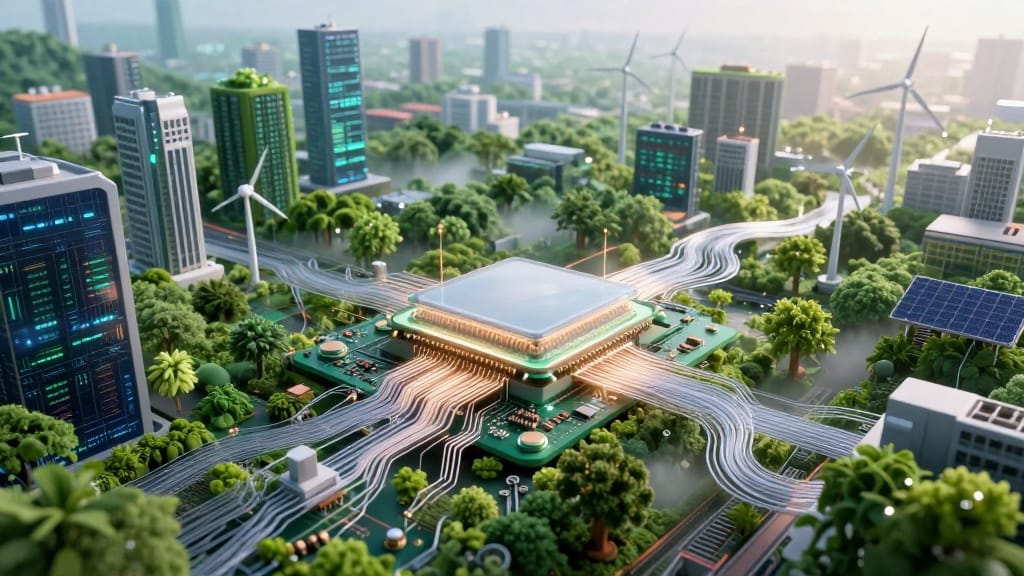
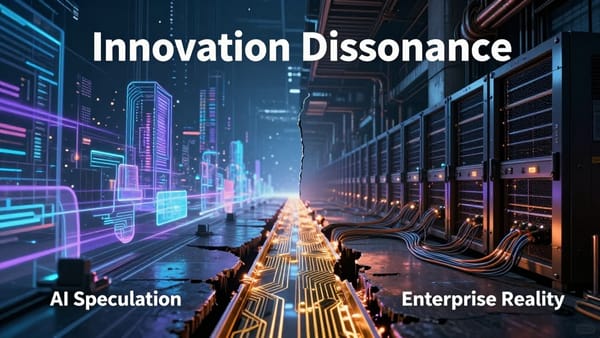
The global technology landscape is currently undergoing a structural transformation, characterized by a fundamental shift in hardware architecture, a renewed focus on industrial sustainability, and the maturation of digital ecosystems in emerging markets. As we move through 2025, the industry is moving past the initial hype phase of generative AI and into a cycle of consolidation and practical implementation. This transition reflects a necessary correction; the era of "growth at any cost" is being replaced by a more disciplined approach focused on operational efficiency and long-term viability. We are witnessing the intersection of high-performance computing and heavy industry, where the digital and physical worlds are synchronized by the common goals of decarbonization and computational optimization. This analysis explores the critical developments across semiconductor manufacturing, sustainable industrial innovation, and the evolving role of open-source software in the modern enterprise, providing a data-driven roadmap for the years ahead. By examining the moves of market leaders and the shifts in foundational research, we can discern the underlying patterns of a maturing global tech economy that prioritizes resilience over mere novelty.
Hardware Consolidation: Nvidia’s Strategic Acquisition of Groq and the Pivot to Inference
In a move that signals a significant shift in the semiconductor industry, Nvidia has reportedly moved to solidify its dominance in the AI inference market. As reported by Reuters, Nvidia is set to acquire the AI chip startup Groq in a deal valued at approximately $20 billion. This acquisition is particularly notable because it targets the "inference" phase of AI—where models process live data to provide answers—rather than just the "training" phase where Nvidia traditionally leads. Historically, Nvidia's dominance was built on the back of GPUs designed for parallel processing, originally intended for graphics but found to be exceptionally adept at the matrix mathematics required for training Large Language Models (LLMs).
However, as AI moves from the laboratory to the production environment, the economics of computing are changing. Training a model is a massive, one-time (or periodic) capital expenditure, but inference is an ongoing operational expense. The strategic value of this deal is further clarified by Seeking Alpha, which notes that Nvidia is licensing Groq’s specialized inference technology while integrating Groq’s executive team into its internal operations. For those unfamiliar with the underlying technology, SDP Noticias explains that Groq’s Language Processing Units (LPUs) are designed for speed and deterministic performance, offering a radically different architecture than traditional GPUs. Unlike GPUs, which rely on complex scheduling and external memory bandwidth that can create bottlenecks, Groq’s architecture allows for predictable, low-latency performance that is essential for real-time applications like autonomous driving and instant voice translation.
This hardware pivot is vital because, as reported by The New York Times, the industry is increasingly questioning the energy efficiency and latency of current AI deployments. The "power wall" has become a tangible threat to the scalability of AI services. By absorbing Groq, Nvidia effectively neutralizes a potential rival while gaining the intellectual property necessary to maintain its lead in the next generation of real-time AI applications. This acquisition suggests that the future of AI hardware will not be a "one size fits all" GPU world, but rather a heterogeneous ecosystem of specialized accelerators designed for specific workloads. From a journalist's perspective, this indicates a narrowing of the competitive field; as the cost of entry for chip design skyrockets, only the giants with deep pockets can afford to integrate the radical architectures necessary for the next leap in efficiency.
Industrial Sustainability and Material Science Innovations
Parallel to the advancements in digital computing, the heavy industrial sector is witnessing a "green" revolution driven by breakthroughs in chemistry and energy management. The narrative of sustainability has shifted from a corporate social responsibility (CSR) obligation to a core driver of industrial engineering. A landmark achievement in decarbonization has been reached with the world’s first million-ton hydrogen-based steel production facility. This transition from coke-ovens to hydrogen-reduction represents a systemic shift in how the most carbon-intensive materials on earth are produced. Steel production has historically accounted for roughly 7% to 9% of global CO2 emissions; the ability to scale hydrogen-based DRI (Direct Reduced Iron) technology to a million-ton capacity proves that "Green Steel" is no longer a pilot project, but a commercially viable reality.
Furthermore, research into the longevity and utility of advanced materials is accelerating, providing the physical foundation for the digital age. A recent study highlighted by Phys.org explores the sustainability of functionalized graphene materials, suggesting that the future of electronics and infrastructure may rest on our ability to manipulate carbon at the molecular level sustainably. Graphene, often cited as a "wonder material," has faced challenges in scalable, eco-friendly manufacturing. The current research focuses on functionalization—modifying graphene to interact better with other materials—which could lead to more efficient batteries, stronger lightweight composites, and even more effective water filtration systems. This focus on durability and efficiency is also a central theme in urban development. As TechGraph observes, tech-driven urban innovation is reshaping sustainable real estate in India’s emerging cities, where smart grids and IoT-enabled resource management are becoming standard rather than elective features.
The implications here are profound. In emerging economies, the leapfrogging of traditional, inefficient infrastructure allows for the creation of "living cities" that respond in real-time to energy demands and water usage. The data-driven insights from these smart cities provide a feedback loop for material scientists, who can then refine products to meet the actual environmental stresses of urban environments. This convergence of material science and digital oversight creates a more resilient industrial base, capable of weathering both economic volatility and the physical impacts of climate change. We are moving toward a circular industrial economy where the waste of one process—be it heat from a data center or byproduct from a chemical plant—becomes the fuel for another. The technical challenge of 2025 is not just to build more, but to build with a sense of finite resource management.
The Human Element: Health, Mobility, and Global Standards
Technological innovation is rarely meaningful unless it addresses human needs and aligns with geopolitical standards. The recent Science and Technology Daily report outlines the top sci-tech news of 2025, emphasizing global collaboration in foundational research. Despite geopolitical tensions, there is a clear consensus that "big science"—from fusion energy to genomic mapping—requires a shared international framework. This progress is mirrored in healthcare, where individual pioneers are bridging the gap between technology and patient care. A notable example is the work of Dr. Benjamin George, whose journey underscores the importance of compassion-driven innovation in oncology. By integrating advanced diagnostics with a personalized, patient-centric approach, medical professionals are ensuring that survival rates are not just statistics, but reflections of improved quality of life.
The mobility sector is also undergoing a radical reimagining, shifting away from the traditional internal combustion engine toward integrated, multi-modal systems. At the latest industry showcases, Hyundai presented its vision for the future, which integrates robotics and hydrogen energy into personal transportation. These advancements suggest that the vehicles of 2030 will be less about transit and more about integrated mobile living spaces. Hyundai’s "Software Defined Everything" (SDx) strategy indicates a future where the car is a node in a larger digital network, capable of autonomous errands, energy storage for the home, and seamless connectivity with other smart devices. This is not merely about changing the fuel source; it is about redefining the relationship between the individual and the urban environment.
However, as Interesting Engineering notes in an interview with Patrick Planing, the success of these innovations depends heavily on public acceptance and the seamless integration of technology into daily routines. Planing highlights that the "psychological infrastructure" is just as important as the physical one. If users do not trust autonomous systems or find hydrogen refueling stations to be cumbersome, even the most advanced technology will fail to achieve market penetration. This "human-centric" design philosophy is becoming the benchmark for success in 2025. It is no longer enough for a technology to be "better" in a laboratory; it must be intuitive, accessible, and demonstrably beneficial to the average citizen’s life. The transition to advanced mobility and health-tech will thus be measured not by the speed of the hardware, but by the rate of social trust and adoption.
Software Sovereignty and the Role of Open Source
While hardware and infrastructure dominate headlines, the underlying software philosophy of the corporate world is shifting toward "Free and Open Source Software" (FOSS). This movement is not just ideological but practical, driven by the need for transparency, security, and economic independence. In an era where "vendor lock-in" can become a strategic liability, open-source provides a pathway to digital sovereignty. According to GaliciaPress, nearly nine out of ten companies with more than ten employees are now utilizing open-source solutions to ensure data sovereignty and reduce licensing costs. This trend is particularly strong in the European Union, where regulations like the AI Act and the Data Act encourage interoperability and open standards.
The drive for software efficiency is also reaching the individual user, who is becoming increasingly tech-literate and resistant to controlled ecosystems. Advanced users are advocating for "cleaner" digital environments, free from the telemetry and overhead of modern proprietary operating systems. For instance, XDA Developers highlights a growing trend among tech enthusiasts to avoid "bloatware" and unnecessary background programs that degrade PC performance and compromise privacy. This movement toward "minimalist computing" is a direct response to the increasing resource demands of modern software. This sentiment is echoed by The Register, which argues for the longevity of hardware through FOSS, suggesting that users can "keep their OS" and maintain control over their devices long after official manufacturer support ends. By switching to Linux-based distributions or other open-source alternatives, users can extend the life of their hardware by years, performing a practical form of sustainability that reduces e-waste.
Finally, we are seeing the emergence of highly specialized digital markets in regions previously overlooked by major tech hubs, proving that the digital economy is becoming truly global. A new report from Jilikh on Cambodia’s digital gaming market projects a significant expansion by 2026, illustrating how mobile connectivity and digital payment infrastructure are creating new economic engines in Southeast Asia. This growth is not just about entertainment; it is about the "fintech-ification" of daily life. In Cambodia and similar markets, gaming platforms often serve as the entry point for digital wallets and e-commerce participation. This bottom-up digital transformation shows that the next billion internet users will likely interact with the web through mobile-first, decentralized, and often open-source-driven platforms. The globalization of software means that innovation is no longer a one-way street from Silicon Valley to the rest of the world; it is a multi-directional exchange of ideas, code, and economic models.
Data Sovereignty and the Geopolitical Tech Landscape
As we analyze the shifts in 2025, we cannot ignore the role of data as the "new oil," though perhaps a more apt comparison would be "new soil"—the foundation upon which all modern services are grown. The concept of data sovereignty is moving from a legal abstraction to a technical requirement. Nations and regional blocs are increasingly demanding that data generated within their borders be stored and processed locally. This has led to the rise of "sovereign clouds," where providers like Oracle, AWS, and Microsoft are forced to build localized infrastructure that adheres to specific national security and privacy laws. This fragmentation of the global cloud is a counter-trend to the globalization of software, creating a complex web of compliance that enterprises must navigate.
The impact of this is felt most acutely in the field of Artificial Intelligence. Training a model on a global dataset is relatively straightforward, but deploying that model in a way that respects the data privacy laws of 50 different countries is a monumental engineering challenge. This is where the acquisition of specialized inference hardware, like Groq’s LPU, becomes even more relevant. If a company must run AI inference "at the edge" (locally) to comply with sovereignty laws, they need hardware that is not just fast, but extremely power-efficient and capable of running on smaller, localized servers. We are moving away from the era of massive, centralized "hyperscale" data centers toward a more distributed architecture where "Micro Data Centers" handle localized processing. This shift supports the sustainability goals mentioned earlier, as it reduces the energy needed for long-distance data transmission and allows for better integration with local renewable energy sources.
Furthermore, the geopolitical competition for semiconductor self-sufficiency remains a primary driver of tech policy. The United States, the European Union, and China are all pouring billions into domestic chip fabrication. However, as the 2025 landscape shows, the real "moat" is not just in fabrication (the "fab"), but in the Electronic Design Automation (EDA) software and the specialized intellectual property (IP) like the kind developed by Groq. The tech observer must look past the factory walls and into the patent offices and open-source repositories to see where the real power lies. The democratization of design through open-source RISC-V architecture is one such area to watch, as it provides a way for smaller nations to develop their own silicon without relying on proprietary Western or Eastern IP. This layer of "Silicon Sovereignty" will be the next frontier of the global tech tug-of-war.
Conclusion: The Practical Future and the Integration of Everything
The synthesis of the diverse developments analyzed here paints a picture of a technology sector that is finally entering its era of maturity. We are moving away from the "move fast and break things" era—a period characterized by speculative bubbles and unchecked resource consumption—toward one of "build efficiently and scale sustainably." The acquisition of Groq by Nvidia suggests that the AI industry is entering a phase of hardware refinement where specialized inference capability is as valuable as raw training power. We are no longer just building bigger models; we are building smarter ways to use them. This reflects a broader industry-wide realization that performance is meaningless without efficiency.
Simultaneously, the success of hydrogen-based steel and the widespread adoption of open-source software across European and Asian enterprises indicate that sustainability and transparency are no longer merely marketing buzzwords—they are operational necessities for survival in a resource-constrained and highly regulated world. The integration of robotics in mobility, the advancement of oncology through personalized tech, and the rise of digital markets in Southeast Asia all point to a world where technology is more deeply, and perhaps more quietly, embedded in the fabric of daily life. The "hype" has faded, replaced by the hard work of infrastructure building.
Looking forward, the tech observer should watch for the "trickle-down" effect of these high-level shifts. As industrial processes become greener and AI chips become more efficient, we can expect a second wave of consumer-facing products that are more affordable, less energy-intensive, and more deeply integrated into the physical world. The true innovation of 2025 lies not in the invention of a single "killer app" or a flashy new gadget, but in the intelligent integration of these disparate advancements into a cohesive, sustainable global infrastructure. We are building the foundations of a resilient digital civilization, one chip, one line of open-source code, and one ton of green steel at a time. The path forward is complex, but the focus on practical utility over ephemeral trends suggests a more stable and productive era for the global technology industry.