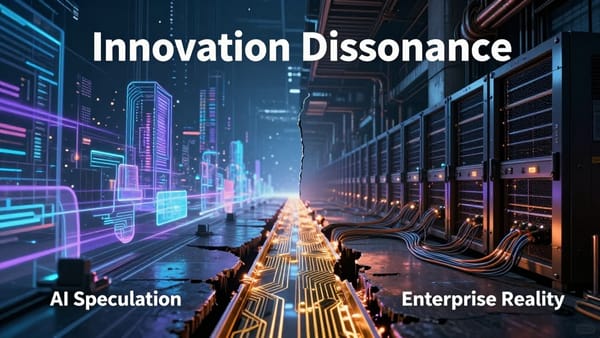
The Convergence of AI and Hardware: Navigating the 2025-2026 Technological Pivot

As we transition into a new era of computing, the technological landscape is being reshaped by a fundamental shift from general-purpose software to specialized, AI-driven ecosystems. This evolution is characterized by a "silicon-first" mentality where hardware is increasingly customized to handle large language models (LLMs) and autonomous processes at the edge. The years 2025 and 2026 represent a critical pivot point: the industry is graduating from the erratic "hype" phase of generative AI and entering a period of structural integration. This transition is not merely about faster chips or larger models; it is about a holistic reconfiguration of how compute power is distributed, governed, and monetized.
Historically, the technology sector has followed a pendulum swing between centralized and decentralized processing. The cloud-first era of the 2010s prioritized massive data centers, but the latency and privacy requirements of modern AI are forcing that power back into the palm of the user’s hand. Simultaneously, the industry is grappling with the logistical and ethical implications of this rapid expansion, from the systemic waste of underutilized administrative software in the public sector to the intensifying complexities of international intellectual property law. Analyzing the trends of 2025 and the projections for 2026 reveals a sector that is more powerful and pervasive than ever before, yet also one that faces unprecedented scrutiny from regulators and a maturing, more skeptical consumer base. This report examines the technical, economic, and social vectors defining this transformation.
The Intelligent Edge: AI Dominance in Consumer Hardware
The consumer technology market has reached a definitive baseline where "generic" performance metrics—such as raw clock speed or traditional RAM capacity—are being overshadowed by neural processing capabilities. According to TechRadar, the defining trends of 2025 across phones, computing, and gaming have focused heavily on integrated AI assistants that operate locally rather than relying on cloud-based API calls. This shift is a direct response to two major pressures: the rising cost of cloud compute for developers and the increasing demand for data sovereignty among privacy-conscious consumers.
In the smartphone sector, the "AI Phone" has transitioned from a buzzword to a hardware requirement. We are seeing the emergence of NPUs (Neural Processing Units) that are no longer secondary to the CPU and GPU, but are instead the primary architects of the user experience. This manifests in real-time language translation, advanced computational photography that mimics professional-grade optics, and predictive battery management. The implications for the semiconductor industry are profound; we are witnessing a divergence where "legacy" silicon is being commoditized, while specialized AI silicon commands premium margins. This hardware maturation is essential for the viability of agentic AI—software that doesn't just answer questions but performs actions on behalf of the user within the device’s OS.
Anticipating the physical manifestation of these trends, PC Gamer notes that the upcoming hardware cycle at CES 2026 is expected to feature new Intel chips designed specifically to manage "far too much AI." This suggests that even in the gaming and enthusiast space, the focus is shifting away from pure rasterization toward AI-driven frame generation, noise reduction, and procedural asset creation. Furthermore, niche innovations are receiving mainstream recognition as they solve specific sensor-based problems. For example, Clarion Ledger reports that InTheTech has already secured a CES 2026 Innovation Award for its Eyas Focus technology. Such developments illustrate how specialized vision and focus utilities—once relegated to heavy industrial use—are becoming central to the consumer hardware value proposition, particularly in the realm of accessibility and professional creative tools.
As we move toward 2026, the challenge for manufacturers will be power efficiency. Running LLMs locally is an energy-intensive process that threatens to negate the battery life gains of the last decade. Consequently, the next frontier of hardware innovation isn't just about "more" AI, but "efficient" AI. This involves the development of 2-nanometer and 1.8-nanometer fabrication processes and the implementation of sophisticated "small language models" (SLMs) that can provide 90% of a large model's utility at 10% of the power cost. The bifurcation of the market between power-hungry flagship devices and efficient, AI-optimized mid-range hardware will likely be the primary narrative of the 2026 retail cycle.
Engineering Feats and Global Manufacturing Realities
While consumer gadgets capture the public imagination, the underlying engineering innovations are what sustain long-term economic growth. The year 2025 has been a landmark for "embedded intelligence" in physical infrastructure. As highlighted by Popular Science, there have been significant breakthroughs in civil and mechanical engineering that integrate smart sensors directly into the structural components of bridges, power grids, and transit systems. These sensors use machine learning to predict structural fatigue before it becomes visible to the human eye, shifting the paradigm of public safety from reactive repair to proactive maintenance.
However, the global manufacturing landscape is currently experiencing a period of intense friction. As the world moves toward a more localized "just-in-case" supply chain model, emerging economies are struggling to move up the value chain. In the Indian market, for instance, Hindustan Times suggests that local phone brands are facing a critical dilemma where innovation—rather than simple assembly or manufacturing—must become the primary focus to compete with global incumbents from China and the US. For these brands, the "manufacturing" hurdle has largely been cleared, but the "intellectual property" hurdle remains. Without proprietary software skins or unique hardware-AI integrations, local brands risk becoming mere "white-label" distributors for foreign technologies.
This need for diversification is also evident in traditional industrial firms that grew to prominence in the analog era. As reported by The Hindu Business Line, Indo National (the company behind Nippo) is charting diversified growth plans to remain relevant in a market that is rapidly moving away from legacy hardware like disposable batteries toward integrated energy storage solutions. This pivot is emblematic of a broader industrial trend: companies that once specialized in "dumb" components are being forced to reinvent themselves as hardware-software hybrids.
Looking further ahead, the technological roadmap is becoming increasingly esoteric. IEEE Spectrum identifies the key technologies of 2026 that will likely bridge the gap between experimental engineering and mass-market applicability. Specifically, advancements in solid-state batteries and quantum signaling are expected to leave the laboratory and enter initial pilot programs. Quantum signaling, in particular, could revolutionize how secure communications are handled in an era where traditional encryption is increasingly vulnerable to AI-driven brute-force attacks. The transition from 2025 to 2026 will thus be remembered as the era when "deep tech"—technologies with high barriers to entry and long development cycles—finally began to impact the average consumer's life.
Software Optimization: From Productivity to Fiscal Management
In the software realm, the narrative is shifting from "feature bloat" to "utility optimization." For the better part of a decade, the Software-as-a-Service (SaaS) model encouraged developers to add unnecessary complexity to justify recurring subscription fees. However, a "subscription fatigue" has set in among both individual users and enterprise clients. For individual users, this has led to a notable resurgence in self-reliance and the adoption of decentralized tools. As shared by How-To Geek, many users are finding that underrated open-source applications are now robust enough to replace high-cost paid tools from dominant players like Adobe or Microsoft. This "open-source renaissance" is driven by a desire for data ownership and a rejection of the "rent-to-own" software philosophy.
This sentiment is echoed by productivity experts who have spent 2025 testing the influx of AI-enhanced task managers. XDA Developers highlights only a select few productivity tools from 2025 that managed to provide lasting value beyond the initial hype phase. The consensus is that users are no longer impressed by AI that simply "writes text"; they are looking for AI that can organize complex workflows, automate calendar management, and filter the noise of digital over-communication. The tools that survived the 2025 market shakeout were those that prioritized a clean user interface over a long list of questionable "AI" features.
For more critical tasks, such as legal and financial compliance, the stakes of software quality are significantly higher. According to CNET, the best tax software of 2025 has integrated AI to simplify complex filings and detect errors in real-time, though manual oversight remains essential to ensure compliance with shifting tax codes. However, when software is poorly managed or over-purchased at a systemic level, the results are fiscally detrimental. A sobering example is found in the public sector; as reported by Fox Baltimore, a Baltimore County OIG report recently revealed significant taxpayer money wasted on underutilized software programs. This highlights a growing epidemic of "shelfware"—software licenses that are purchased but never deployed or used—costing municipalities and corporations billions of dollars annually. As we head into 2026, the demand for digital audit practices and "software-rationalization" tools will likely skyrocket as CFOs look to trim the fat from their IT budgets.
The movement toward 2026 will be defined by "invisible software." Instead of interacting with dozens of different applications, users will increasingly interact with an "orchestration layer" that uses AI to pull data and functionality from various sources in the background. This shift will favor platforms that offer open APIs and robust integration capabilities over "walled gardens." The victory for software in 2026 will not be measured by "time on app," but by how quickly and efficiently a task was completed, marking a return to the original promise of computing: the augmentation of human intent through efficient automation.
The Regulatory and Scientific Frontier
As technology reaches deeper into the fabric of daily life, the legal and scientific frameworks governing it must undergo a corresponding transformation. Intellectual property (IP) has become the primary battleground for the next decade of innovation. IPWatchdog provides 2026 predictions suggesting that AI-generated patentable subject matter will be one of the most contentious issues of the year. The core question—can an AI be an "inventor"?—remains unsettled in many jurisdictions, creating a climate of uncertainty for R&D-heavy industries. If AI-generated discoveries cannot be patented, the incentive for pharmaceutical and engineering firms to invest in AI discovery engines could be severely stifled.
Investors are also watching the software market's financial stability through a lens of technical analysis rather than just narrative enthusiasm. For example, Defense World reports that Software Aktiengesellschaft’s stock price has recently passed above its 200-day moving average. For market analysts, this is a key indicator of a sustained bullish trend in the enterprise software sector, suggesting that despite the "shelfware" concerns, the long-term outlook for foundational software infrastructure remains strong. This financial stability is crucial as tech giants face increasing antitrust pressure and calls for greater transparency in their algorithmic decision-making processes.
Beyond these terrestrial and economic concerns, the search for advanced technology has extended into the cosmos, utilizing our most advanced terrestrial technologies to scan for signs of life. According to Sky at Night Magazine, the search for "alien technosignatures" is gaining scientific traction, utilizing the same hypersensitive sensors and machine learning algorithms used in modern telecommunications. By training AI to recognize patterns that deviate from natural cosmic phenomena, astronomers can scan vast swaths of the electromagnetic spectrum that were previously unmanageable. This represents the ultimate "big data" problem, where AI is the only tool capable of finding a needle in a galactic haystack.
While we look to the stars for evidence of advanced civilizations, we must not neglect our own personal digital hygiene. As practical advice from Wired suggests, foundational tech cleanup tasks—such as securing passwords with passkeys, purging unused cloud data, and updating firmware—remain the most effective ways to ensure our personal technological ecosystems remain functional. Security in 2026 will be less about reacting to breaches and more about "zero-trust" architectures and biometrics. The boundary between our physical selves and our digital identities is blurring; thus, the technical maintenance of the self has become as important as the maintenance of any physical asset. The upcoming year will likely see a surge in "identity-as-a-service" platforms that promise to protect users in an increasingly fractured and AI-saturated information environment.
Conclusion: The Analytical View of 2026
The data suggests that the technology sector is moving away from the "move fast and break things" era and into a period of refinement, integration, and accountability. The focus has shifted from whether AI can perform a task to how efficiently and ethically it can do so within the constraints of modern hardware and tightening legal frameworks. As we look toward 2026, the success of a technology will likely be measured not by its novelty, but by its ability to integrate seamlessly into a more conscientious and audited digital world. We are seeing a convergence of interests: consumers wanting privacy, corporations wanting efficiency, and governments wanting oversight.
The "Technological Pivot" of 2025-2026 is ultimately about maturity. Whether it is through the lens of open-source software adoption as a counter-culture to SaaS, the engineering of "intelligent" bridges, or the search for technosignatures in deep space, the industry is entering its most complex chapter yet. It is no longer enough to innovate; one must now innovate with a clear understanding of the environmental, social, and fiscal consequences. For the observer, this period offers a fascinating case study in how a global society adapts to the realization that technology is no longer a tool we use, but an environment in which we live. The winners of 2026 will be those who prioritize sustainability—both of the planet and of the user’s cognitive load—over the short-term dopamine hits of "revolutionary" but ultimately impractical features.