The Adaptive Edge: Navigating the Intersection of AI Disruption and Infrastructure Evolution


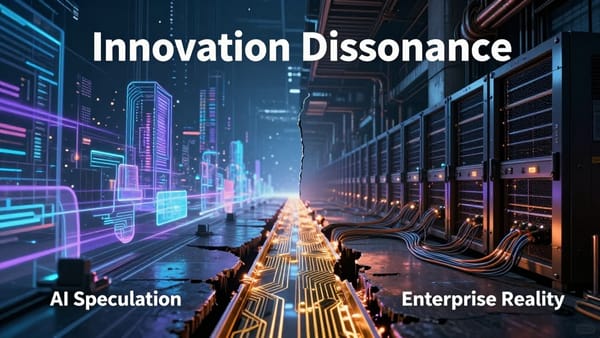
The global technology sector is entering 2026 characterized by a stark divergence between legacy infrastructure stability and the disruptive potential of artificial intelligence. We have moved past the era of pure speculation. While major industrial and financial players grapple with the physical requirements of innovation—ranging from large-scale regional technology parks to statewide system overhauls—the software landscape is facing a profound revaluation. We are no longer observing a simple growth trend; rather, we are seeing a shift where "innovation" is being scrutinized for its tangible software delivery and fundamental economic value. The market is increasingly rewarding "low-level" reliability—the chips, the glass, and the power—while penalizing high-level software that fails to provide a defensive moat against generative automation. This article analyzes how these pressures are reshaping everything from corporate earnings and public sector administration to the very nature of software longevity and military preparedness. In this environment, the "Adaptive Edge" belongs to those who can bridge the gap between abstract algorithmic power and the concrete physical infrastructure required to sustain it.
The Earnings Divergence: Infrastructure vs. Speculative Valuations
As the first quarter of 2026 begins, the financial health of the technology sector is being viewed through two distinct lenses: the providers of essential hardware and the software firms threatened by AI automation. According to Yahoo Finance, four specific stocks—SNDK, APH, ASML, and GLW—are positioned to potentially beat Q4 earnings expectations. This signal is significant because it highlights a "flight to quality" within the supply chain. ASML, as the sole provider of extreme ultraviolet (EUV) lithography machines, represents the absolute floor of the semiconductor industry. Without their hardware, the next generation of AI chips simply does not exist. Similarly, Amphenol (APH) and Corning (GLW) represent the literal connective tissue—connectors and fiber optics—necessary for the massive data center expansions currently being funded by hyperscalers.
The resilience of these hardware-centric firms suggests that the "picks and shovels" of the industry remain in high demand despite broader market volatility. When institutional investors lean into companies like Corning, they are making a bet on the physical reality that AI requires more bandwidth and more light-speed data transmission than 2024-level infrastructure could provide. This isn't just about a quarterly beat; it's about the fundamental retooling of the global economy to support a compute-heavy future. We are seeing a move away from "software-first" toward "infrastructure-first" investment strategies, as the limitations of power grids and data transfer speeds become the primary bottlenecks for AI scaling.
Conversely, the software-as-a-service (SaaS) model is facing its most significant "survival of the fittest" scenario since the 2000 dot-com crash. A report from Barchart highlights that Citi has cut targets for Datadog (DDOG), Fastly (FSLY), and Atlassian (TEAM), warning that these entities may be replaced by AI-native solutions before the market can fully reprice their value. The logic here is brutal: if an AI can write code, monitor systems, and manage workflows, what happens to the multi-billion dollar companies whose primary product is a dashboard for those tasks? Atlassian, for instance, faces a world where Jira tickets are autonomously generated, triaged, and resolved by LLM-agents. If the human element is removed from the workflow, the "per seat" pricing model collapses.
This sentiment is echoed in a critical analysis of the electric vehicle giant Tesla. Seeking Alpha characterizes Tesla (TSLA) as a speculative asset with a valuation disconnected from its fundamental automotive margins. While Tesla enthusiasts argue the company is an AI and robotics firm, the financial reality remains tethered to the physical delivery of vehicles—a market experiencing intensifying competition and margin compression. This highlights the central tension of 2026: a company's ability to market itself as "AI-driven" is no longer enough to sustain a premium valuation. Investors are now demanding to see how that AI translates into defensive market positioning or superior unit economics in the real world.
Infrastructure and Litigation: The Growing Pains of Modernization
Building the physical backbone of the digital age is proving to be a litigious and socially complex endeavor. The expansion of the technology sector often encounters significant local resistance, illustrating the tension between regional economic goals and community sovereignty. In New York, the Town of Maine has filed a lawsuit against the Broome County Industrial Development Agency (IDA) regarding a proposed 545-acre technology park. This is not an isolated incident; it represents a growing "NIMBY" (Not In My Backyard) movement targeting the physical footprint of the cloud. These technology parks are essential for housing the servers and cooling systems that run modern AI, yet they require massive land acquisition, water resources, and energy draws that local communities are increasingly unwilling to concede without a fight.
The Broome County case underscores the complexities of environmental impact assessments in the 2020s. A 545-acre development is not merely a collection of buildings; it is a permanent alteration of the local ecology and utility load. As tech companies seek to move away from saturated hubs like Northern Virginia or Silicon Valley, they are running headlong into the realities of small-town governance and rural preservation. This friction creates a "deployment lag" that could potentially slow the rollout of new AI capabilities, as the legal system becomes a primary bottleneck for technological growth. It forces companies to become better diplomats, moving beyond simple economic promises toward comprehensive community integration strategies.
While some regions fight expansion, others are forced into modernization by necessity. As reported by nny360.com, DMV offices across New York will temporarily close for a statewide technology upgrade. This reflects an urgent, long-overdue need to modernize aging public sector systems. For decades, "legacy debt"—the use of ancient COBOL-based systems and siloed databases—has hindered the efficiency of government services. The closure of physical offices for a digital upgrade signals that the delta between private sector technology and public sector reality has reached a breaking point. These upgrades are not just about faster processing; they are about data security and the ability to interface with modern identity verification tools.
In the private sphere, companies like Progress Software demonstrate that disciplined operational focus can still yield results. Their Q4 earnings call presentation revealed how established software providers are finding paths toward consistent revenue by focusing on mission-critical applications. By providing the tools that other businesses use to build their internal software, Progress occupies a "middle-layer" that is more resilient to AI disruption than pure consumer-facing apps. They represent the "boring but essential" side of tech that keeps the world's gears turning while the flashier parts of the market experience turbulence.
Analytical Applications: From Cold Cases to National Defense
The true value of any technology is found in its application to human problems. We are currently seeing a renaissance in forensic technology, where computational power is being applied to solve long-standing humanitarian and legal challenges. In a remarkable demonstration of this, authorities in Nashville successfully identified a human skull found in a 35-year-old cold case. This was made possible not by a single breakthrough, but by the convergence of advanced DNA sequencing and massive genealogical databases—a task that requires significant processing power and sophisticated algorithmic matching.
This application of technology moves beyond the laboratory and into the realm of social justice and closure for families. It provides a blueprint for how AI and big data can be used for the public good, rather than just for optimizing ad revenue. When we look at the historical context of forensic science, the leap from fingerprinting to DNA was monumental; the leap from DNA to "forensic genealogy aided by machine learning" is equally transformative. It allows investigators to reconstruct identities from partial, degraded samples that would have been useless a decade ago. This represents the "humanized" side of the technological edge—the use of innovation to mend the fabric of the past.
On the international stage, the stakes of innovation are even higher, as military systems transition toward decentralized, tech-driven defense frameworks. According to The Guardian, President Zelenskyy has stated that military innovation involving "mobile fire groups" and interceptor drones will transform Ukraine’s air defenses. This is a dramatic shift away from centralized, billion-dollar missile batteries toward modular, rapid-response technology. It is a war of attrition being fought with silicon. These "mobile fire groups" utilize real-time data from networked sensors to intercept threats, effectively turning the battlefield into a high-stakes Internet of Things (IoT) environment.
This shift reflects a broader trend of "Manufacturing at the speed of innovation," a concept explored by DEVELOP3D. The central question for 2026 is whether the industrial base can maintain its pace as sustainability and personalization become central requirements. In a military context, "speed of innovation" means the ability to modify drone software or hardware in a 24-hour cycle to counter emerging electronic warfare tactics. This requires a much tighter integration between software developers and factory floors than what existed during the Cold War. The "Adaptive Edge" here is literally the difference between survival and obsolescence, as the traditional five-year development cycles of major defense contractors are being outpaced by iterative, software-defined military hardware.
The Human Element: Education, Labor, and Leisure
Despite the march of automation, the human element remains the primary driver and beneficiary of the technological ecosystem. In the educational sector, there is a growing recognition of the role of technology in driving perpetual evolution. We are moving away from the "static degree" model of education toward a world where learning is a continuous, AI-curated process tailored to individual needs. In this vision, education is not something you finish; it is a system you integrate with to keep your skills relevant in a market where the half-life of knowledge is shrinking rapidly.
This evolution impacts the labor market in surprising ways. While basic coding tasks are being automated, high-level engineering expertise remains at a premium. For instance, companies like SOUTHWORKS are seeking Senior Software Engineers within LATAM time zones to handle complex desktop and C# development. This signals that for project-based contract work—especially in legacy-critical languages like C#—human expertise is still vital. AI can assist, but the architecture of complex, cross-platform systems still requires the nuanced judgment of a senior human engineer who understands the "technical debt" of the systems they are building upon.
The labor market of 2026 is characterized by this "high-end" resilience. Those who can navigate the "un-automatable"—complex system architecture, cross-cultural team management, and ethical oversight—are seeing their value rise. Meanwhile, the middle-management layer that primarily handled information relay is finding itself squeezed out by automated workflows. It is a "K-shaped" labor recovery where the most skilled and the most personally effective workers thrive, while those performing "process-based" tasks are displaced by the very software they used to use.
Even our daily leisure and software interactions are being optimized for longevity and engagement. Recent reports show how software updates are extending the life of Smart TVs, allowing consumers to unlock new features without the need for hardware replacement. This "software-defined hardware" approach is a victory for both the consumer and sustainability efforts, as it moves us away from a "throwaway" gadget culture. This mentality extends to the casual gaming space, where the New York Times puzzles have become a daily staple for millions. Users seeking optimization for their mental routines can find guidance for Wordle #1677 hints or the latest NYT Strands answers via Forbes. These micro-engagements with technology reflect a broader cultural integration where software is expected to provide both utility and consistent intellectual engagement, grounding the user in a daily digital ritual.
Conclusion: The Path Forward
The synthesis of these developments reveals a technology sector that is finally maturing. We are exiting the "gold rush" phase of AI and enters the "settler" phase, where the winners are defined by their ability to provide tangible, defensible value. The "hype cycles" are being replaced by a more grounded reality where physical constraints like power, land, and chips dictate the pace of progress. AI is no longer a futuristic promise but a current filter: those who use it to improve local infrastructure, solve decades-old cold cases, or modernize air defenses are moving the needle. Meanwhile, those whose business models were built on the friction of human administrative tasks are finding that friction liquidated by automation.
As we move through 2026, the focus will remain on whether manufacturing can scale fast enough to meet the demands of these specialized innovations, and whether our public institutions—like the New York DMV or municipal governments—can adapt their digital backbones to keep pace with these private sector shifts. The technology is here; the challenge now lies in the "implementation gap." Those who can bridge the divide between the virtual potential of AI and the physical needs of a complex, litigious, and resource-constrained world will own the next decade. Success in this era requires more than just a better algorithm; it requires an "Adaptive Edge" that integrates hardware, software, and human expertise into a single, resilient whole.