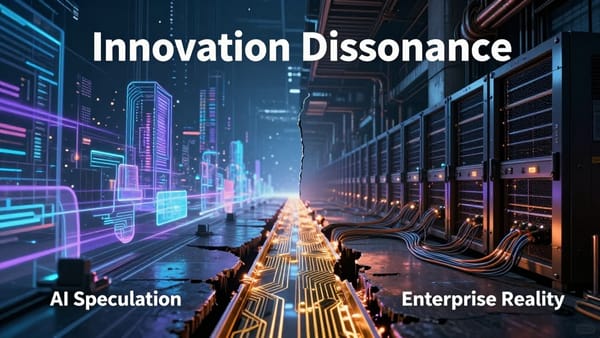
The 2026 Tech Landscape: Hardware Prowess Meets the AI Accountability Era

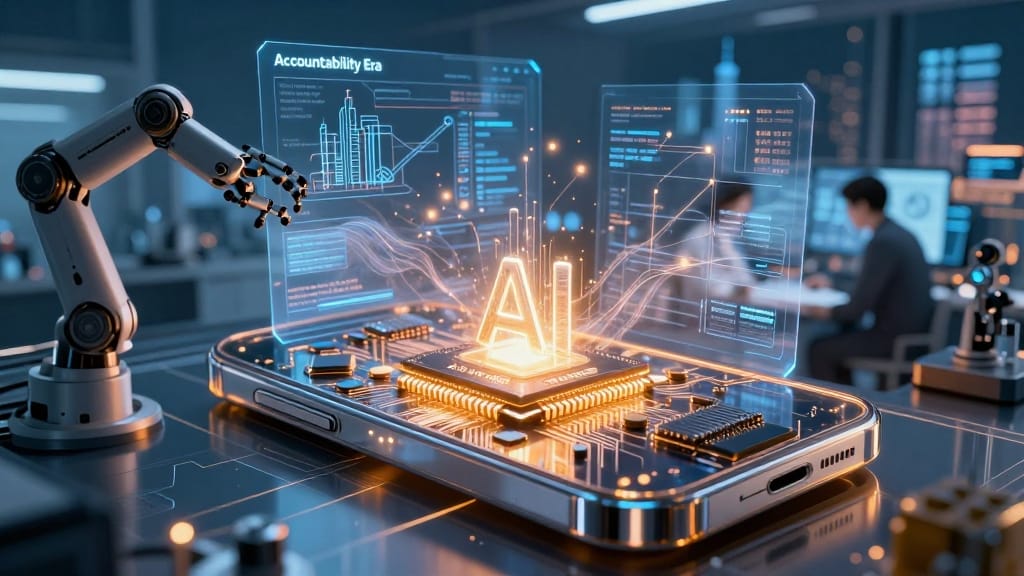
The dawn of 2026 marks a significant transition in the technological lifecycle. We are moving beyond the initial novelty of generative software toward a more complex era defined by physical integration and industrial accountability. This year’s Consumer Electronics Show (CES) has highlighted a shift from AI as a digital assistant to AI as a tangible component of hardware, while the financial markets and legal sectors simultaneously grapple with the infrastructure and liability of these advancements. This report analyzes how semiconductor growth, autonomous logistics, and a growing tension between creative professionals and automated tools are reshaping the global economy. In prior years, the "AI revolution" felt largely localized to the cloud—a series of chatbots and image generators that existed behind a screen. Today, the narrative has shifted toward the "edge," where the silicon in our pockets and the sensors in our logistical networks are being re-engineered to handle localized, high-stakes decision-making. As we examine these shifts, the overarching theme is no longer whether AI will be used, but how reliably it can be governed and how effectively the underlying hardware can support its increasingly massive computational demands. This requires a sober look at the supply chains, the ethical frameworks, and the tangible gadgets that are currently redefining the boundaries of human-machine interaction.
From the hardware innovations powering next-generation foldables to the integration of autonomous trucking into national supply chains, the current trajectory suggests that the "intelligence" of our devices is finally catching up to the capabilities of our networks. However, this progress is met with a cultural and professional friction that cannot be ignored. The following analysis explores the convergence of these forces, providing a data-driven look at the companies and technologies leading the charge into the latter half of the decade.
The Physicality of AI: Innovations from CES 2026 and the Hardware Shift
The Consumer Electronics Show has long served as a barometer for the year’s consumer sentiment. In 2026, the trend is unmistakably focused on turning AI into a physical, interactive presence. According to Tech Times, devices such as the Lepro Ami and the Tiiny AI Pocket Lab demonstrate that AI is moving out of the browser and into handheld, companionship-focused hardware. This shift suggests a move away from generalized LLMs (Large Language Models) toward specialized "pocket labs" and creative assistants that interact with the physical world in real-time. The move to edge-based processing in these handheld devices is significant; it reduces latency and increases privacy, two factors that have historically hindered the mass adoption of always-on AI assistants. By processing data locally, these gadgets bypass the "cloud-latency" that often makes voice-activated tech feel sluggish and disconnected from the immediate environment.
Hardware form factors are also evolving to accommodate these new user behaviors. As reported by BGR, the Lenovo Legion Pro Rollable laptop and the Jackery Solar Mars Bot represent a push toward more adaptable, mobile-first designs. The rollable display technology, in particular, addresses a longstanding tension in mobile computing: the desire for screen real estate versus the need for portability. In 2026, we see this coming to fruition not just as a gimmick, but as a functional necessity for multitasking in AI-heavy workflows. These are complemented by advancements in visual processing, such as Nvidia’s DLSS 4.5, which continues to push the boundaries of AI-driven graphical fidelity. Furthermore, Tech Times notes that innovation in sleek, durable designs may finally address the durability "pain points" of premium foldables, potentially benefiting the long-rumored entrant in the category, the iPhone Fold. If Apple enters the foldable market in 2026, it will likely be because the materials science—specifically the ultra-thin glass and hinge mechanics—has finally reached a level of industrial reliability that meets the brand’s rigorous internal standards. This shift toward "AI-inside" hardware signals a departure from the "AI-as-a-service" model. Instead, we are entering an era where the hardware itself is the primary differentiator, and the software is a deeply integrated, invisible layer of the user experience.
Consider the broader implications for the consumer: as gadgets become more autonomous, the nature of "ownership" may change. A device like the Solar Mars Bot is not merely a battery; it is an autonomous energy-hunting robot. This represents a leap in how we perceive tools—moving from passive objects to active participants in our domestic environments. The technical challenge remains how to power these high-draw AI chips without significantly increasing device weight or heat. The 2026 cohort of devices suggests that manufacturers are betting on "asymmetric" computing, where specialized NPU (Neural Processing Unit) cores handle the heavy lifting, allowing the main CPU to remain relatively power-efficient. This architectural shift is what enables a "Pocket Lab" to perform complex chemical or environmental analysis without thermal throttling. As we pivot from consumer gadgets to the industrial backbone of these innovations, the scale of requirements grows exponentially.
Semiconductor Infrastructure and the Logistics of Autonomy
Analytical data suggests that the demand for the silicon underlying these innovations remains insatiable. The transition from "software-defined" to "AI-defined" infrastructure has placed an unprecedented burden on memory and logic manufacturers. Citigroup recently signaled high confidence in the memory market, raising its price objective for Micron Technology to $385.00. This bullish stance is driven by the necessity of high-bandwidth memory (HBM) to process the 30 percent of software code that leaders like Satya Nadella admit is now AI-generated, as discussed in PCWorld. The sheer volume of AI-driven development is putting pressure on both hardware manufacturers and the software giants themselves. Without the requisite DRAM and Flash memory components, the most advanced GPUs remain bottlenecks, unable to feed the hungry neural networks they were designed to train. This "memory wall" is perhaps the most significant hurdle facing the industry in 2026, and firms like Micron are essentially the architects of the bridge over it.
The practical application of this computing power is perhaps most visible in the transportation sector, where the margin for error is zero. In a major milestone for autonomous logistics, Yahoo Finance reports that McLeod Software has completed the API integration of the Aurora Driver ahead of schedule. This allows carriers to book autonomous capacity within their existing Transportation Management Systems (TMS). This integration represents a shift from "testing" autonomous trucks to operationalizing them, a move that could fundamentally restructure national supply chains. By integrating directly into the TMS, Aurora isn't just a "self-driving truck company"—it becomes a capacity provider, indistinguishable from a human-driven carrier in the digital logistics stack. For logistics providers, the benefits are quantifiable: 24/7 hauling capabilities, optimized fuel efficiency through AI-driven throttle control, and a reduction in the volatility of driver turnover. This isn't just about replacing drivers; it's about building a "parallel infrastructure" that can handle the surge capacity requirements of a globalized economy.
However, the transition to autonomous logistics also presents a regulatory and safety paradox. While the McLeod/Aurora integration streamlines the booking process, insurance markets are still calibrating how to price the risk of a fully automated long-haul fleet. The 2026 landscape is defined by this "readiness gap"—the tech is ready, the software is integrated, but the legal frameworks are still undergoing stress tests. From a hardware perspective, these trucks are mobile data centers, requiring robust sensors and high-redundancy computing to navigate variable weather and unpredictable human traffic. The convergence of Micron's memory prowess and Aurora’s logistical integration highlights a critical truth: the AI revolution is only as fast as its slowest physical component. For the freight industry, this means that while software can be deployed in an instant, the rollout of physical autonomous units will take years of capital expenditure and infrastructure hardening.
The Creative and Ethical Friction of AI Integration
However, the rapid deployment of AI is not without significant pushback. The photography community is currently at the center of a heated debate regarding toolsets that automate complex editing. As detailed by Fstoppers, professional photographers who once embraced AI tools are now expressing a sense of "betrayal" as software like Evoto simplifies advanced skills—such as high-end retouching, frequency separation, and color grading—to mere slider controls. The software has become so efficient that Fstoppers also reported on official responses from the company regarding rumors that they are moving to make human photographers obsolete. This friction illustrates a broader crisis of identity in creative professions: if a machine can replicate the results of a decade's worth of "craft" training in seconds, what remains of the professional’s value? The backlash against Evoto suggests that we are moving past the "AI-as-a-helper" honeymoon phase and into a more protectionist era where human talent is fighting to maintain its premium status.
This friction extends to the corporate and legal spheres. At Microsoft, the aggressive push into AI—initially resisted by Bill Gates but championed through a $1 billion bet on OpenAI—is under public scrutiny. According to Windows Central, some users have gone as far as creating browser extensions to mock the company’s perceived "sloppiness" in its AI-heavy software era, using terms like "Microslop" to describe the bloating of Windows and Office with half-baked AI features. This reflects a growing "AI fatigue" among power users who prioritize reliability and system performance over experimental features. Moreover, the integration of generative tools into the operating system has raised concerns about data sovereignty and the involuntary training of models on user data. The tension between "shipping fast" and "shipping correctly" has never been more visible, and Microsoft’s trillion-dollar valuation is increasingly tied to its ability to prove that its AI investments can yield stable, professional-grade results.
The legal implications of this "sloppiness" are profound, especially as AI enters more regulated sectors. As artificial intelligence enters the insurance sector, JD Supra warns of a growing tension between automation and accountability, particularly regarding liability in AI-driven claims processing. If an AI incorrectly denies a health insurance claim or miscalculates risk for a homeowner, where does the "buck stop"? The potential for algorithmic bias and the "black box" nature of deep learning models mean that insurance companies face significant litigation risks. In 2026, we are seeing the rise of "AI auditing," a new sub-industry designed to provide the transparency that traditional legal systems require. This era of accountability is forcing developers to move away from purely experimental models and toward "explainable AI," where the reasoning behind a decision can be traced and defended in a court of law. This shift toward accountability is the hallmark of technology’s transition from a "growth" phase to a "maturity" phase.
Precision Medicine and Emerging Financial Ecosystems
While consumer tech faces growing pains and creative friction, the healthcare sector is seeing high-trust gains. This is because, in medicine, AI is being used as a precision tool rather than a generic content generator. OncoHost was recently named a Top 10 innovator and won the 2026 BIG Innovation Award for its work in precision medicine. By using technology to improve patient outcomes through personalized treatment paths—specifically by analyzing the host response to cancer therapies—OncoHost demonstrates the "high-stakes" success of AI when applied to complex scientific data. This represents a more stable and ethically clear use case for the technology: using machine learning to find patterns in biological data that human researchers might overlook. It turns AI from a "replacement" into a "force multiplier" for oncologists, effectively moving the needle on survival rates by tailoring medicine to the Individual's unique protein profile.
The financial world is also pivoting as it looks for the infrastructure best suited for a high-speed, automated future. In the cryptocurrency space, Multicoin Capital's Kyle Samani has publicly urged institutional giants like BlackRock and Fidelity to prioritize Solana over Ethereum. As reported by The Street, this reflects a broader industry debate over which blockchain can provide the throughput and low latency required for the next generation of decentralized finance (DeFi) applications. For institutional players, the "settlement time" of a blockchain is just as critical as the semiconductor speed in a data center. If the 2026 economy is to run on automated smart contracts, the underlying "digital ledger" must be able to handle millions of transactions per second without the high fees and congestion that have historically plagued early blockchain networks. This debate mirrors the hardware shifts we see in the PC market: it is no longer enough to be "novel"; the technology must be "performant."
The convergence of precision medicine and high-speed blockchain signals a move toward a "trustless" but highly accurate economy. In the healthcare example, the trust is built through validated patient outcomes; in the financial example, it is built through cryptographically secured transaction speed. Both sectors are moving away from the "move fast and break things" ethos of the early 2020s toward a "measure twice, cut once" philosophy. This maturity is necessary as institutional money begins to flow into these sectors with greater intensity. Whether it is a pension fund investing in Solana or a hospital group adopting OncoHost’s platform, the requirement for 2026 is robustness. The era of the "unprofitable tech experiment" is largely over, replaced by a demand for tangible ROI and industrial-grade reliability. This evolution suggests that while AI and blockchain were once seen as speculative bubbles, they are being distilled into the essential components of our modern economic engine.
Maintaining Perspective in a Fast-Moving Market
As we navigate these advancements, it is helpful to recall the historical context of technology to avoid being swept up in the immediate hype cycle. BuzzFeed recently highlighted how wildly different everyday technology looked in past centuries, reminding us that today’s "disruptive" tools will eventually be seen as primitive precursors. This historical perspective is a necessary antidote to the techno-determinism that often dominates our current discourse. We are at a point where the speed of change can lead to "future shock," where the human capacity to adapt is outpaced by the silicon’s capacity to evolve. Yet, even in this high-tech landscape, human nature remains remarkably consistent. Millions still rely on cognitive puzzles for routine engagement, seeking help for the latest Wordle or the New York Times Pips puzzles to sharpen their minds. This suggests that as our environment becomes more automated, we crave small, controlled challenges that reaffirm our own cognitive agency.
The future of technology in 2026 and beyond will likely be defined by how we balance this rapid innovation with human oversight. Whether it is the integration of autonomous trucks or the "physicalization" of AI gadgets, the success of these technologies will depend on their ability to solve real-world problems without compromising the accountability of the people who use them. We are witnessing the end of the "black box" era, where software companies could hide behind the complexity of their algorithms. Today’s consumers and regulators are demanding transparency, not just efficiency. The focus has moved from what AI can do to what AI *should* do, and the answer will determine the next decade of digital growth. As we integrate these tools into the very fabric of our lives—from our medical treatments to our supply chains—we must ensure that the "intelligence" we are creating remains a tool of human progress rather than an uncontrollable artifact of our own ingenuity.
Concluding our analysis, the tech landscape of 2026 is one of tempered optimism. The hardware to power a new age of intelligence is being minted in the foundries of Micron and Nvidia, and the logistical frameworks are being integrated by pioneers like McLeod and Aurora. Yet, the social contract between the professional class and the automated tools they use is being rewritten in real-time. This is not a passive transition; it is an active negotiation. The winners of this era will not just be those with the fastest chips or the largest models, but those who can build trust in an age where the line between human and machine is increasingly blurred. As we look forward, the objective of the Tech Observer remains unchanged: to demystify the complex, prioritize the practical, and maintain a steady gaze on the data that shapes our world. The narrative of 2026 is still being written, but the ink is now physical, silicon-based, and increasingly accountable.