The 2026 Tech Landscape: Agentic AI, Computing Shifts, and the Great Software Consolidation

The arrival of 2026 has signaled a definitive pivot in the global technology narrative. We have moved beyond the initial "shock and awe" phase of Large Language Models (LLMs) and entered a period of cold, calculated execution. The superficial charm of conversational chatbots has faded, replaced by the demanding requirements of "agentic" systems—AI architectures that do not merely synthesize text, but possess the capacity to execute multi-step workflows across disparate digital environments. This transition is not merely a software update; it is a fundamental re-architecting of how humans interact with silicon. As we observe the fallout from major industry events like CES 2026, it is clear that the tech industry is no longer throwing ideas at the wall to see what sticks. Instead, the focus has narrowed toward creating a seamless, albeit aggressive, integration of artificial intelligence into the very fabric of our operating systems and hardware.
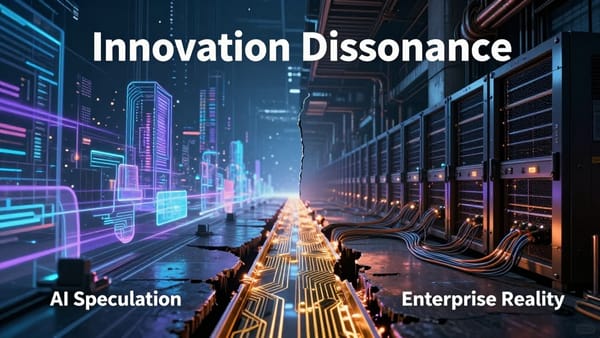
This evolution is occurring against a backdrop of significant hardware breakthroughs and a ruthless consolidation of software ecosystems. From Intel’s high-stakes gamble on its 18A manufacturing process to Microsoft’s systematic retirement of legacy applications, the industry is undergoing a "Great Cull." We are seeing the death of the standalone, single-purpose application and the birth of the unified, AI-driven environment. However, this progress is not without friction. A growing movement of digital sovereignty is emerging as users begin to push back against "AI bloat," seeking to reclaim control over their personal and professional computing spaces. In this comprehensive analysis, we examine the shifting tides of 2026, focusing on the practical implications for enterprises, developers, and the average consumer who must now navigate a world where software is no longer a tool, but an autonomous participant.
Key Takeaways
- Agentic AI takes center stage: A fundamental shift from conversational bots like ChatGPT to "agentic" software that automates complex, multi-step information work with minimal human oversight.
- Silicon evolution: Intel’s 18A process and Panther Lake chips have finally reached the market, enabling high-performance, multi-tasking mobile computing that rivals desktop power.
- The "Great Cull": Microsoft and other tier-one software providers are sunsetting dozens of legacy apps to centralize user experiences around Copilot and unified, modular ecosystems.
- Hardware diversification: Former niche players like Dreame Technology are utilizing AI-driven manufacturing to pivot into the luxury automotive and hypercar space, challenging established incumbents.
- The Sovereignty Movement: Growing consumer and regulatory demand for "de-AI" tools that allow users to strip automated features and tracking from their operating systems for the sake of privacy and performance.
The Rise of the AI Agent: From Chatbots to Autonomous Coworkers
For the preceding three years, the technology sector was largely defined by the novelty of Generative AI. We marveled at its ability to write poetry or summarize meeting notes. However, as noted by Axios, the competitive landscape has moved decisively toward "agentic" software. This represents a paradigm shift from passive assistance—where a human must prompt every action—to active participation, where an agent is given a high-level goal and figures out the sequence of clicks, data fetches, and communications required to achieve it. This is the "Coworker" era of AI, where the system is expected to manage the "drudge work" of information management autonomously.
Anthropic has emerged as a primary driver of this trend with its latest research preview. Their "Claude Cowork" system allows its models to handle multifaceted actions within a computer environment, such as navigating a web browser, filling out complex forms, or managing file directories. According to ZDNET, this feature is currently gated behind the high-tier Claude Max subscription. However, the rollout is accompanied by significant "use at your own risk" warnings. The risks are not merely hallucinations; giving an AI agency over a live operating system creates a massive security surface area. If an agent is tricked by a malicious website into deleting files or exfiltrating data, the consequences are far more severe than a simple factual error in a chat window. Industry analysts suggest that 2026 will be the year we see the first major legal and insurance frameworks established to handle "agent error."
The impact of this agency is perhaps most visible in the software development lifecycle. The days of using AI just for "boilerplate" code are ending. ZDNET reports that developers are now successfully utilizing sophisticated tools like ChatGPT’s Codex 5.2 to resolve high-level architectural debugging. This involves the AI understanding the entire context of a repository, identifying memory leaks, and proposing refactors that maintain system integrity. This level of technical competence is democratizing complex coding tasks, allowing junior-level developers to perform at a mid-senior level while simultaneously creating a saturated market for entry-level talent. The "agent" here serves as a senior reviewer who never sleeps. As these systems become more integrated, the question is no longer whether AI can code, but how much human oversight is required to prevent "automated technical debt"—situations where AI-generated code works today but becomes a maintenance nightmare tomorrow because it lacks a long-term architectural vision.
Hardware Breakthroughs: 18A Silicon and the New Computing Standard
The ambition of agentic software is strictly limited by the hardware on which it runs. In previous years, the latency involved in sending every command to a cloud server made large-scale AI agents impractical for real-time tasks. CES 2026, however, showcased the hardware solutions necessary to bring this processing "to the edge." Intel, after years of intense competition and manufacturing delays, has finally delivered on its promised 18A process technology. As reported by The Outerhaven, the new Panther Lake architecture is specifically designed for the AI-first era. These chips provide the necessary Neural Processing Unit (NPU) throughput to run agentic models locally, ensuring privacy and eliminating the lag that previously hindered autonomous workflows.
This leap in silicon density and efficiency is not just an incremental improvement; it is a fundamental shift in the "two-laptop" culture of professional creatives and developers. Previously, a professional might need a slim laptop for travel and a heavy workstation for video encoding or compiling. Panther Lake promises to collapse these categories, offering "workstation" performance in a mobile form factor. This enables what PR Newswire and MIT Technology Review highlight as a critical breakthrough for 2026: decentralized AI. When your laptop can process a 70-billion parameter model without calling a data center, the nature of personal computing changes. The operating system becomes less of a portal to the cloud and more of a localized brain.
Furthermore, the arrival of ultra-efficient, highly powerful AI chips has allowed non-traditional players to enter highly competitive hardware verticals. A prime example is Dreame Technology. Once relegated to the world of high-end robot vacuums, Dreame leveraged its expertise in high-speed motors and AI-driven spatial mapping to pivot into the luxury automotive sector. According to Gear Patrol, the unveiling of the Nebula Next 01 hypercar at CES 2026 shocked the industry. The vehicle utilizes advanced AI for everything from aerodynamic adjustments to situational awareness, targeting the high-performance market currently dominated by legends like Bugatti. This illustrates a key 2026 trend: AI-first design is allowing hardware companies to jump across traditional industry boundaries with unprecedented speed, as the "intelligence" of the product becomes more valuable than the traditional mechanical heritage of its makers.
The Software Funeral: Consolidation and the Resistance Movement
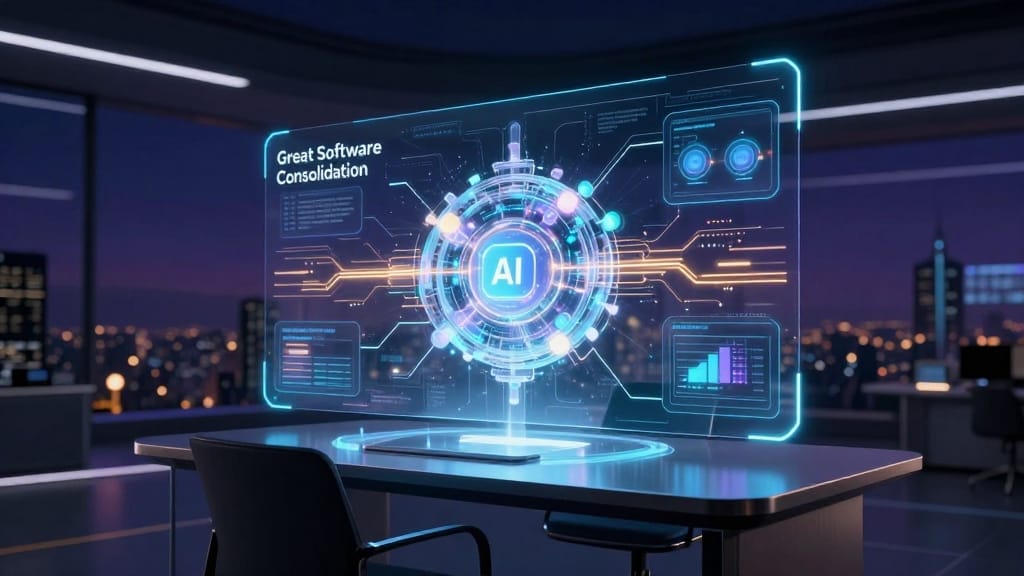
As the "intelligence" layer of the operating system matures, a brutal consolidation of the software market is occurring. Major platforms are moving away from maintaining dozens of specialized apps and instead integrating those features into a single AI-driven interface. The Register characterizes 2026 as a year of "software funerals," particularly within the Microsoft ecosystem. For decades, Windows and its associated suites have been a sprawling archipelago of legacy apps (Notepad, Paint, Mail, Snipping Tool). Now, Microsoft is systematically sunsetting these standalone tools to centralize functionality around Microsoft 365 Copilot. The goal is a unified user experience where the user describes a task, and Copilot pulls in the necessary modular tools behind the scenes.
The transition is especially visible in the mobile space. As noted by XDA-Developers, several long-standing mobile applications are being shuttered in favor of an integrated mobile Copilot app. For IT administrators, this "Great Cull" is a double-edged sword. While it simplifies license management and security patching, it also breaks existing workflows and creates a dependency on a single AI orchestrator. The concern is that if Copilot fails or its "reasoning" changes through an update, the entire productivity stack of a corporation could be paralyzed. This consolidation is pushing the software world toward a "platform-as-an-agent" model, where the brand of your AI matters more than the specific features of your individual apps.
However, every action has an equal and opposite reaction. The forced integration of AI into every corner of the digital experience has sparked a significant backlash. A vocal segment of users—ranging from privacy advocates to efficiency purists—is actively resisting the "AI-ification" of their computers. As reported by ZDNET, search queries for "how to remove Copilot" and "disable AI tracking" have reached record highs. Users are becoming frustrated with the "bloat" that comes when an OS tries to predict their every move, often slowing down the system in the process. In Europe, this resistance has birthed a new category of "sovereignty software." ComputerHoy highlights the emergence of "Winslop," a community-driven utility that strips Windows 11 of its AI integrations, advertisements, and telemetry. This represents a burgeoning divide in the market: the corporate vision of an AI-led future versus a grassroots movement for "dumb" but reliable and private computing environments.
Vertical Innovation: Specialized High-Growth Sectors
While the consumer-facing AI wars dominate the headlines, the real economic growth of 2026 is happening in specialized, mission-critical environments. General-purpose AI models are impressive, but they lack the "last mile" expertise required for high-stakes fields like life sciences and precision engineering. We are seeing a massive investment in the physical and digital infrastructure required to support these niche applications. For instance, PR Newswire reports that TransMedics is significantly expanding its footprint at the Assembly Innovation Park. This move underscores a critical reality: as software becomes more ethereal, the physical centers where it is developed and applied to biological or mechanical systems become more valuable.
The financial scale of this specialized software shift is immense. According to GlobeNewswire, the global software development services market is on a trajectory to reach approximately $772.47 billion. This growth is no longer driven by "app development" in the traditional sense, but by the demand for custom AI and machine learning integrations that can handle proprietary datasets securely. Companies are no longer satisfied with a general-purpose model; they want a "private" AI trained on their own legal documents, medical records, or supply chain data. This demand for custom solutions is keeping the service industry afloat even as automated coding tools threaten to replace standard programming tasks.
In this landscape of rapid change, "boring" reliability has become a premium feature. While startups are launching experimental AI-only accounting tools, established players are doubling down on trust and compliance. PR Newswire notes that QuickBooks remains the most trusted platform for tax in 2026. This highlights a persistent market truth: when it comes to the IRS or regulatory compliance, businesses prefer a "tax-ready" platform with decades of history over a shiny new AI agent that might hallucinate a new tax deduction. The successful companies of 2026 are those that have successfully layered AI-driven insights on top of a bedrock of proven, reliable functionality. They use AI to find savings, but they use traditional, hard-coded rules to ensure the math is always correct.
Conclusion: Navigating the Era of Integrated Intelligence
The overarching theme of 2026 is the transition from "possibility" to "integration." We have moved past the era where a technological advancement was celebrated simply because it was novel. Today, the focus is on whether that advancement can survive the rigorous demands of enterprise workflows, data privacy laws, and user fatigue. As ZDNET reports in its summary of the year’s major electronics showcases, the dominant trend is no longer "standalone" smart gadgets. Instead, players like Samsung, LG, and Hisense are presenting an "Internet of Agency," where your refrigerator, laptop, and car share a unified AI model that manages your schedule and domestic energy usage with minimal intervention.
As we look forward, the industry faces a profound philosophical tension. On one side stands the corporate push for an "AI-first" world, where convenience is optimized through total data integration and automated agency. On the other side is an increasingly savvy consumer base demanding digital sovereignty—the right to use a computer that is merely a tool, not a monitoring or mediating agent. For businesses, the challenge of 2026 is one of balance: how to leverage the immense productivity gains of agentic AI without alienating users or creating systemic dependencies on fragile automated systems. The winners of this era will not be the ones with the most powerful AI, but the ones who best master the trust required to let that AI act on our behalf. We have built the machines that can act; now we must decide how much we are willing to let them do.