The 2026 Innovation Dissonance: Bridging the Gap Between AI Speculation and Enterprise Reality

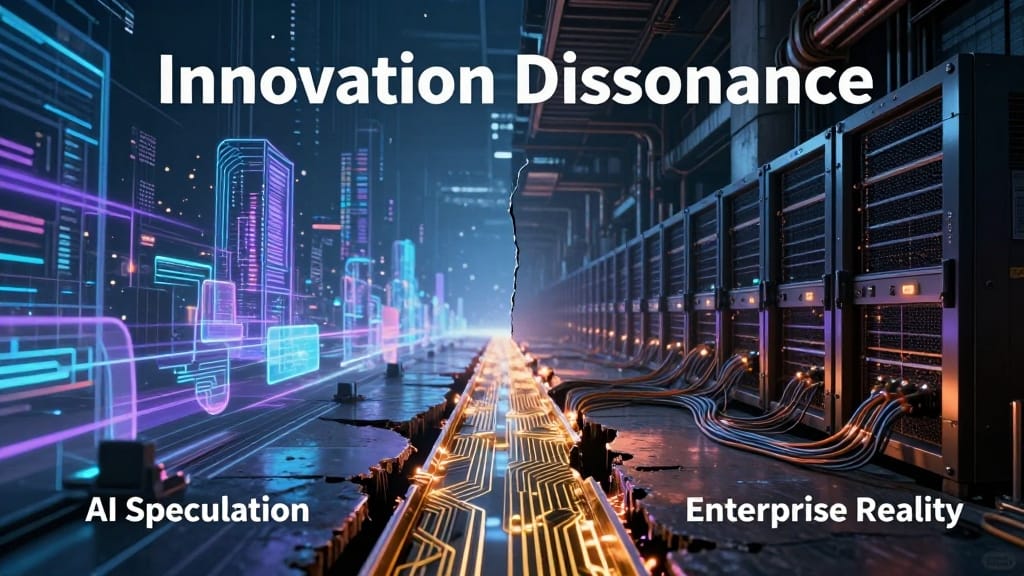
The technology landscape in early 2026 is defined by a striking contradiction that I have come to call the "Innovation Dissonance." While foundational breakthroughs in semiconductor hardware and generative architecture continue to accelerate at a non-linear pace, the financial and operational integration of these tools is facing a period of intense, sober re-evaluation. The "move fast and break things" era of generative AI—a period characterized by unbridled optimism and venture capital saturation—is transitioning into a phase where pragmatic management decisions, regulatory frameworks, and market volatility dictate the actual velocity of progress. Leading software firms, once the darlings of the digital transformation era, are facing "oversold" status on major exchanges as investors pivot from potential to proven profitability. Simultaneously, legacy gadgets are reaching their final expiration dates, signaling a move toward cloud-dependent, hardware-integrated ecosystems that prioritize efficiency over novelty.
This report analyzes the shifting dynamics of the tech sector, moving beyond the headlines to examine the structural changes within the industry. From the strategic realignments of silicon giants like Nvidia to the sobering reality of AI productivity gains in the global developer community, the focus has shifted to sustainability. We will explore how innovation is being institutionalized through initiatives like Arizona Tech Week and the National Inventors Hall of Fame, while also addressing the somber geopolitical tensions surrounding technological sovereignty. By synthesizing these diverse developments, this analysis provides a forensic look at the practical implications of today's most significant technological trends, offering a roadmap for navigating an environment where the delta between hype and utility is finally beginning to close.
The Software Bear Market: Navigating "AI Anxiety" and Fiscal Realignment
The current fiscal quarter has revealed a paradoxical trend in the global equity markets that challenges the narrative of an uninterrupted AI boom. Despite the ubiquitous presence of artificial intelligence in corporate roadmaps, many of the industry’s most prominent software providers are struggling to maintain their valuations in a "show-me" market. According to CNBC, software giants such as Intuit and Palantir were among the most "oversold" stocks in the S&P 500 recently. This stands in sharp contrast to memory-chip manufacturers and silicon foundries, which remains "overbought," indicating a massive capital preference for the "picks and shovels" of the AI gold rush over the applications themselves.
This decline suggests a strategic "buy the dip" dilemma for institutional investors who must determine if these companies are undervalued or if their business models are being fundamentally disrupted by the very technology they are trying to implement. Barchart reports that ServiceNow and other high-profile software stocks have entered a bear market, largely driven by what analysts term "AI anxiety." This anxiety stems from a growing realization: integrating a Large Language Model (LLM) into a software suite does not inherently create a proprietary advantage if every competitor is utilizing the same underlying APIs. The market is now demanding clear evidence of "value capture"—the ability to translate AI features into higher Average Revenue Per User (ARPU) or significant churn reduction.
The financial pressure is further exacerbated by shifting fiscal policies on the international stage. As noted in CNBC TV18, Budget 2026 announcements regarding hikes in Securities Transaction Tax (STT) for futures and options trading could significantly influence how tech-heavy portfolios are managed, particularly on exchanges with high volumes of retail and algorithmic trading. This regulatory shift forces a more disciplined approach to tech investment, moving away from high-leverage speculation toward long-term equity holding. In this environment, software companies can no longer rely on the "AI halo" to sustain their multiples; they must demonstrate that their use of agents and automated workflows can replace human labor costs or unlock entirely new revenue streams that were previously unattainable without cognitive automation.
Hardware Synergy and the Departure from Cosmetic Gadgetry
While software valuations undergo a painful correction, the hardware infrastructure that supports the digital economy is being reinforced by unprecedented capital commitments and strategic consolidation. A critical moment in this narrative appeared when Nvidia CEO Jensen Huang proactively addressed industry rumors regarding a fallout with his primary customer base. As reported by Business Standard, Huang denied reports of friction with OpenAI, instead emphasizing a "huge investment" plan. This move confirms that the symbiotic relationship between the provider of the "computation engine" and the creator of the "intelligence engine" is the most vital axis in modern technology. This alliance is no longer about shipping discrete chips; it is about building massive-scale data centers that function as a single, unified computer.
The shift toward hardware efficiency is also trickling down to the consumer and open-source levels, where the era of "bloatware" is yielding to performance-centric architecture. For example, the Shotcut 26.1 video editor recently introduced long-awaited hardware video decoding, utilizing VA-API on Linux and Video Toolbox on macOS, according to Linuxiac. This focus on utilizing specialized silicon for specific tasks—rather than relying on general CPU power—mirrors the broader enterprise trend toward "ASIC-centric" (Application-Specific Integrated Circuit) computing. Furthermore, the Budgie Desktop 10.10.1 release, which offers improved Wayland support as noted by Linuxiac, demonstrates a industry-wide pivot toward modern display protocols that offer better power efficiency and security.
Conversely, the industry is witnessing a "culling of the herd" regarding gimmicky or redundant devices. BGR reports that five major tech gadgets died in 2025, losing their functionality as manufacturers pivot toward cloud-dependent ecosystems and "all-in-one" AI-powered smartphones. The death of these gadgets marks the end of the "accessory era," where consumers were expected to carry multiple discrete devices for tasks that a single multimodal AI agent can now handle. This transition is not without risk, however, as it increases consumer reliance on a small handful of platform providers, raising questions about data sovereignty and the longevity of software-as-a-service (SaaS) backed hardware. If the cloud components of these devices are retired, the physical hardware becomes "e-waste," a cycle that is increasingly drawing the attention of environmental and consumer rights regulators.
The Evolution of Agency: Transitioning from Automation to Collaborative Intelligence
As basic generative automation becomes a commodity, the next frontier of innovation lies in "agentic workflows"—systems where AI does not just respond to prompts but acts autonomously to achieve complex goals. A fascinating and perhaps prophetic manifestation of this is Moltbook, a digital environment where artificial intelligence agents interact with one another in a social network format. As analyzed by The Financial Express, Moltbook allows AI agents to communicate, bargain, and experiment. This is not merely a novelty; it is a sandbox for the next generation of collaborative intelligence. By observing how AI agents interact without human intervention, researchers can identify "emergent properties"—solutions to problems that human logic might not have initially considered.
Despite the promise of these autonomous systems, the enterprise world is learning that AI is not a "plug-and-play" solution for productivity. High-level management must now discern when a task is appropriate for an agent and when it requires the nuanced judgment of a human. ZDNET argues that AI deployment is ultimately a management decision rather than a purely technical one. The decision to "delegate" to an AI agent involves assessing the cost of error versus the gain in speed—a calculation that varies wildly between a creative marketing firm and a high-stakes medical diagnostic facility. This "managerial filter" is becoming the most critical bottleneck in AI adoption.
In the developer community, the impact of Generative AI has been equally nuanced. There was an initial fear that AI would replace entry-level coders; however, the reality is more complex. Venky Veeraraghavan, chief product officer at Freshworks, noted in another ZDNET report that Generative AI primarily boosts productivity for experienced professionals. Senior developers use these tools to automate boilerplate code, allowing them to focus on high-level architecture. In contrast, junior developers often find themselves overwhelmed by the volume of code generated, struggling to debug errors they don't fully understand. This suggests that instead of replacing humans, AI is widening the gap between high-skill and low-skill labor, potentially increasing the demand for senior "architects" who can oversee the exponential output of AI-assisted systems.
Global Science and the Institutionalization of Innovation Hubs
Innovation in 2026 is no longer confined to the silos of Silicon Valley. It is increasingly being viewed as a collaborative effort spanning borders, industries, and local municipalities. At the UK-China Business Forum, AstraZeneca CEO Pascal Soriot remarked that both nations are a "great match" in their shared focus on biopharmaceutical innovation, as reported by CGTN. This highlights a critical trend: the decoupling of geopolitics from scientific necessity. In fields like oncology and rare disease research, the scale of data required is so vast that no single nation can achieve breakthroughs in isolation. This "scientific pragmatism" provides a necessary counterweight to the technological protectionism seen in the semiconductor industry.
This spirit of partnership is also redefining how software is implemented at the enterprise level. The era of the "unaware vendor" is over; clients now demand deep integration and shared outcomes. This philosophy is exemplified by firms like CG Infinity, which prioritizes "success through partnership" in Salesforce implementations. Instead of simply selling licenses, these firms are becoming long-term strategic partners, ensuring that complex CRM (Customer Relationship Management) tools actually deliver the business outcomes they promise. This reflects a broader move away from "software as a service" toward "outcomes as a service."
Domestically, the United States is formalizing its technological legacy while diversifying its geographic footprint. The National Inventors Hall of Fame has announced its 2026 class of innovators, which includes the pioneers of Wi-Fi—a timely reminder of the decades of research required to create the "invisible" infrastructure we take for granted today. Simultaneously, regional tech hubs are gaining unprecedented traction. According to Flagstaff Business News, Arizona Tech Week is showcasing the remarkable growth of the state’s startup and venture capital community. By focusing on niche areas like aerospace, green energy, and optics, cities like Flagstaff are proving that innovation does not require the astronomical cost of living associated with traditional tech epicenters. This decentralization of the "innovation engine" is perhaps the most significant structural change in the domestic tech economy this decade.
Technological Sovereignty and the Geopolitical Risk Framework
Despite the collaborative advancements in medicine and decentralized software development, technology remains a central pillar of national security and a primary source of geopolitical friction. The concept of "technological sovereignty"—the ability of a nation to develop and maintain critical infrastructure without foreign reliance—has moved from a fringe policy idea to a central tenet of global governance. A stark example of this tension can be seen in the Middle East, where Amir Hatami, an advisor to Iran’s supreme leader, issued a warning to western powers. As reported by WION, Hatami asserted that nuclear technology cannot be eliminated through military threats or physical attacks.
This statement encapsulates a broader truth about the modern world: the "permanence of technology." Once a scientific threshold is crossed—whether it is the enrichment of uranium or the development of a specific AGI (Artificial General Intelligence) architecture—the knowledge becomes a permanent fixture of the global landscape. This reality fundamentally changes the nature of international relations. You cannot "bomb" a codebase or an intellectual breakthrough out of existence. Consequently, traditional military power is being supplanted or at least supplemented by digital and scientific resilience. The ability to secure a supply chain of H100 GPUs or to maintain a sovereign LLM that reflects a nation's specific cultural and linguistic values is now as important as traditional border security.
Furthermore, the risks associated with "dual-use" technologies—those that have both civilian and military applications—are becoming more acute. AI-driven cybersecurity is a prime example. An algorithm designed to find vulnerabilities in a corporate firewall can just as easily be used to identify weaknesses in a nation's power grid. This dual nature has led to a fragmented regulatory environment, where companies must navigate a patchwork of "Export Control" lists and data localization laws. The challenge for 2026 and beyond is to foster an environment where "safe" innovation can flourish across borders while preventing the weaponization of the very tools that are meant to drive human progress. The current standoff in nuclear tech serves as a cautionary tale of what happens when technological advancement outpaces diplomatic framework.
Conclusion: The Practical Path Toward Integration
The technological landscape as we traverse 2026 is moving away from the "hype cycles" of the previous decade and toward a more rigorous, performance-based era. The "Innovation Dissonance"—the gap between what technology can do in a lab and what it actually achieves in the economy—is finally beginning to narrow. Whether we look at the consolidation of hardware protocols in tools like Shotcut, the market correction of overvalued software stocks, or the strategic, multi-billion dollar architecture investments from Nvidia and OpenAI, the overarching theme is maturity. We are entering the "Implementation Age."
For businesses and individual professionals, the path forward requires a shift in mindset. Organizations are no longer just asking "what can AI do?" but are instead focusing on the more difficult questions: "Who is experienced enough to manage these agents?" and "How does our underlying hardware support this volume of inference?" The winners in this new era will not necessarily be the companies with the most revolutionary algorithms, but those that can successfully integrate these tools into existing human and physical infrastructures. As regional hubs like Flagstaff demonstrate, innovation is increasingly about community, partnership, and specialized application. The 2026 tech observer must look past the volatility of the stock market and the noise of social media to see the real work of integration happening in the background. It is a period of "quiet progress," where the foundations for the next twenty years of global productivity are being laid, brick by digital brick.