Global Shifts 2026: Navigating the Intersection of AI, Geopolitics, and Economic Transformation

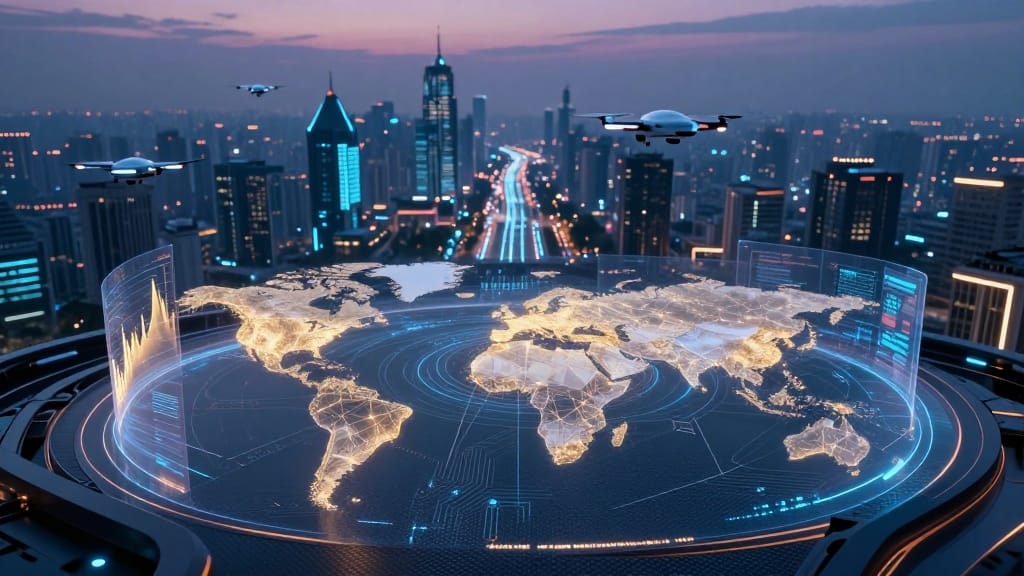
The dawn of 2026 marks a decisive pivot in the global narrative, moving away from the era of "disruption" and into a period of deep, systemic integration. The experimental fervor that defined the early 2020s—characterized by proof-of-concept AI, volatile post-pandemic markets, and fluid diplomatic alignments—has crystallized into a new, more permanent global architecture. This is no longer a world of "emerging" technologies; it is a world where autonomous systems, decentralized commerce, and restructured geopolitical alliances form the very foundation of daily life. Breaking Wire analysts have identified a convergence of forces across 18 critical developments, ranging from the tactical evolution of drone warfare in Eastern Europe to the revolutionary "open commerce" protocols in South Asia. As these disparate threads intertwine, they create a global landscape that is more efficient yet more fragile, demanding a radical rethinking of how we manage assets, borders, and social contracts. This report provides a high-resolution look at the mechanisms driving these changes and the strategic implications for the year ahead.
Geopolitical Friction and the Evolution of Kinetic Conflict
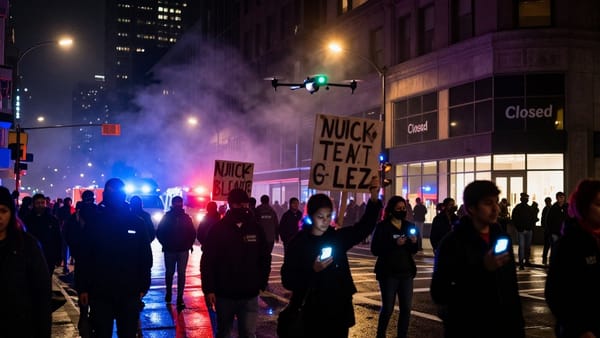
The international security landscape enters 2026 in a state of hyper-vigilance, where the lines between physical combat and cognitive warfare have effectively vanished. The primary catalyst for recent volatility has been the escalating tension in Eastern Europe. Following high-stakes claims regarding a potential assassination attempt directed at the Russian leadership, the rhetorical stakes have reached a fever pitch. However, the Western response has been characterized by deep skepticism. According to Reuters, US and NATO envoys have publicly doubted Moscow's allegations that Ukraine targeted a presidential residence. This skepticism highlights a critical feature of 2026 conflict: the "information war" is now as strategically significant as the "hot war." Officials suggest that such claims may be fabricated to justify further escalations or to consolidate domestic support in the face of a grinding war of attrition.
Beyond the borders of Ukraine, the proxy dynamics of the Middle East have entered a new, more dangerous phase. The proliferation of advanced autonomous weaponry has altered the tactical calculus for regional powers. Detailed investigative reporting from The Associated Press reveals that sophisticated munitions and strategic strikes in Yemen continue to pose a direct threat to the security infrastructures of Saudi Arabia and the UAE. This isn't just about territorial disputes; it represents the democratization of precision-strike capabilities among non-state actors. When a non-state group can deploy technology that was, until recently, the exclusive domain of superpowers, the traditional "deterrence" model fails.
This failure of traditional deterrence is forcing a profound reassessment of diplomatic doctrine. As analyzed by Foreign Affairs, the global consensus is shifting toward a "middle way" in foreign policy. This pragmatic approach eschews the binaries of total interventionism and pure isolationism. It acknowledges that in a multipolar 2026, stability is maintained not through overwhelming force, but through a complex web of adaptive alliances and "limited-objective" engagements. The "middle way" recognizes that the U.S. and its allies cannot be everywhere at once, necessitating a focus on maritime security, technological superiority, and economic resilience rather than nation-building. This strategic shift is significant because it signals an end to the "world’s policeman" era, replacing it with a "world’s critical node" model where influence is exercised through the control of capital, data, and energy pathways.
The implications of this shift are felt in every corner of the globe. In the South China Sea, smaller nations are leveraging this "middle way" to play larger powers against each other, securing infrastructure deals in exchange for neutral status. In Sub-Saharan Africa, the influence of private military contractors and tech-driven security firms is filling the vacuum left by retreating international peacekeepers. What we see is a world that is "de-globalizing" its security but "re-globalizing" its threats. The risk of miscalculation remains high, particularly as AI-driven command systems begin to play a role in fast-tracking military decisions. In this environment, the most valuable intelligence isn't just knowing what the enemy is doing, but knowing what they are *saying* to their own population, as the narrative becomes the primary theater of operations.
The Industrialization of AI: From Chatbots to Autonomous Agents
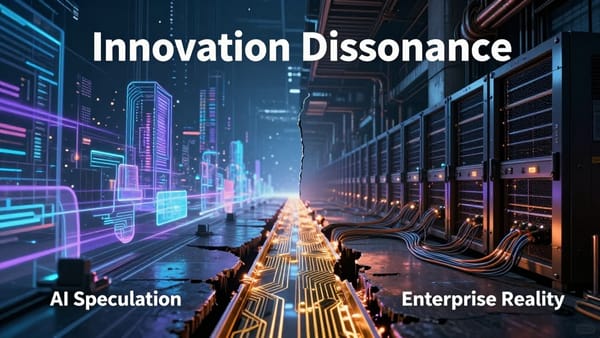
The tech sector has officially graduated from the "hype cycle" of generative artificial intelligence and entered the era of deep industrial integration. If 2023 was the year of the experiment and 2024 was the year of the pilot program, 2026 is the year of the autonomous agent. We are observing a fundamental move away from individual software tools toward holistic systems that possess agency. According to The Times of India, this "next leap" involves AI evolving into systemic infrastructure. These agents do not simply answer questions; they manage procurement, optimize supply chains in real-time, and act as autonomous legal and financial auditors. This shift is turning every company, regardless of its industry, into a "tech-first" organism.
This evolution was not an overnight occurrence but a result of aggressive capital deployment. The TNW (The Next Web) 2025 recap highlighted that AI has become the primary—and in many cases, only—driver of significant venture capital and corporate R&D. The focus has narrowed toward solving the energy and compute bottlenecks that plagued early models. As we look deeper into 2026, The Guardian identifies five key tech trends, including the rise of decentralized web protocols and more energy-efficient hardware. The urgency for "green AI" is paramount; with AI data centers consuming an ever-growing share of the world's power, the winners of 2026 will be those who can provide the most intelligence with the least wattage.
But how did we get here? Historical context provides a roadmap for this acceleration. As CNET recently noted in its analysis of the history of the Consumer Electronics Show (CES), the march toward hyper-connectivity has been decades in the making. From the VCR to the smartphone, each iconic gadget paved the way for the current reality where "hardware" is increasingly just a vessel for "intelligence." In 2026, the gadget is no longer the star; the underlying network of autonomous agents that knows your preferences before you do is the real product. This level of integration impacts everything from healthcare—where AI agents monitor patient vitals and adjust dosages without human intervention—to urban planning, where traffic grids are managed by predictive algorithms that eliminate congestion by dynamic rerouting.
The most profound impact of autonomous AI is on the labor market. While previous iterations of automation targeted blue-collar tasks, the 2026 wave is squarely focused on "cognitive labor." Middle management, legal research, and technical writing are being fundamentally reshaped. However, this is not a one-for-one replacement. Instead, we are seeing the rise of the "Centaur" model—individuals who can seamlessly direct and audit multiple AI agents. This shift necessitates a complete overhaul of educational systems, moving away from rote memorization toward prompt engineering and ethical oversight. The risk, of course, is a "widening of the gap": nations and corporations that cannot afford the compute power required for these systems will find themselves effectively locked out of the global economy's most productive sectors.
The New Commerce Paradigm: Decentralization and Cultural Currency
The global marketplace in 2026 has undergone a structural transformation that favors agility over institutional size. The dominant force here is the democratization of influence, where social media and open-source networks have dismantled the gatekeepers of retail. In the beauty and fashion sectors, the change is particularly stark. The Business of Fashion notes that "social age marketing" has completely upended traditional advertising. No longer do brands tell consumers what is fashionable; instead, influencers and viral community trends dictate production cycles. This has created a "creator-to-consumer" (C2C) pipeline that bypasses traditional retail hierarchies entirely.
This cultural shift has profound economic consequences, creating a new class of billionaires who are themselves the "brand." For instance, CNN reports that Beyoncé’s net worth has soared to billionaire status, a milestone that represents more than just entertainment success. It symbolizes the "artist-as-entrepreneur" model, where intellectual property and a direct-to-fan relationship are the most valuable assets in the global economy. This model is being replicated at all scales, with "micro-influencers" in niche markets generating multi-million dollar annual turnovers by leveraging platforms that automate logistics and sales.
Simultaneously, we are seeing a paradoxical resurgence in the physical world. While the digital marketplace thrives, the demand for human experience has led to a wave of brick-and-mortar growth. Consumers, fatigued by digital saturation, are seeking communal spaces. Cheapism has tracked a significant surge in store and restaurant openings planned for 2026, as brands attempt to create "physical touchpoints" for their digital communities. This resurgence extends into the corporate sphere, where the aesthetics of professional life are being revitalized. As reported by American Livewire, there is a renewed focus on the role of fashion in corporate identity, reflecting a world where "dressing for the office" is less about conformity and more about expressing personal and professional brand alignment in a hybrid-work era.
However, the most technologically significant disruption in commerce is currently occurring in India. The Open Network for Digital Commerce (ONDC) is actively rewiring how digital trade functions by breaking down the monopolies of major e-commerce platforms. As explained by Open The Magazine, this four-year-old initiative is creating a level playing field. By creating a standardized, open-source protocol for trade, a small merchant in a rural village can offer their products across a myriad of buyer apps, effectively competing with global giants. This "protocol-based commerce" is being watched by regulators worldwide as a potential blue-print for breaking up digital monopolies without heavy-handed legislation. If ONDC continues its trajectory, 2026 could be the year the centralized "platform economy" begins its decline, replaced by a truly decentralized "network economy."
Domestic Policy and the Fracturing of the Public Safety Net
While technology and commerce advance at breakneck speed, domestic policy in the United States is struggling to keep pace, leading to a visible fracturing of the public safety net. In 2026, the delivery of essential services has become a flashpoint for political and administrative conflict. A prime example is the recent crisis in the Midwest. The Department of Health and Human Services (HHS) has engaged in a unprecedented freeze of child care payments. According to CBS News, the freeze in Minnesota has left thousands of providers and families in financial limbo. This is not an isolated administrative error; it is symptomatic of a broader ideological shift in the management of federal agencies.
The past year has seen the United States health apparatus undergo its most dramatic transformation in decades. As detailed by The Detroit News, public health policy has been radically reshaped, leading to heated debates over the future of vaccine mandates, agency oversight, and the very definition of "public health." This decentralization of authority is forcing states to take the lead. NPR reports that a record number of states are implementing their own independent family caregiver support policies. This state-level activism is a direct response to an aging population and a federal government that is increasingly retreating from broad social mandates. In 2026, your "safety net" depends less on your passport and more on your zip code.
This administrative reorganization extends to the defense and fiscal sectors. The hiring of officials like Michael Powers as Deputy USW Comptroller, as reported by ExecutiveGov, signals a pivot toward fiscal forensic management within the defense department. The goal is to maximize efficiency in a "lean" budgetary environment, where every dollar spent on traditional hardware must be weighed against the needs of cyber-defense and technological R&D. This "fiscal hawkishness" is creating a more streamlined but also more vulnerable administrative state, where any disruption in digital payment systems—like the child care freeze in Minnesota—can have cascading effects on the vulnerable.
Environmental policy has also transitioned from a regulatory burden to a market-driven engine. We are seeing companies successfully monetize sustainability through the sophisticated use of carbon credits. PR Newswire recently highlighted a massive 21,000-ton carbon-inclusive credit transaction by NaaS Technology. This demonstrates that "green mobility" is no longer just a subsidy-driven experiment but a profitable pillar of 2026 corporate strategy. However, the urgency of this transition is underscored by real-world events. As the BBC reports, the UK continues to grapple with the aftermath of severe flooding, illustrating the high cost of climate inaction. The intersection of policy and safety in 2026 is clear: the market will drive the solutions, but the government must manage the immediate human consequences of a rapidly changing planet.
Conclusion: The Architecture of the New Normal
As we synthesize the developments of late 2025 and 2026, it is evident that the world has entered a "Hard Reset." We have moved past the initial shock of the AI revolution and are now dealing with the more complex task of living within it. The integration of autonomous agents into the global economy, the decentralization of commerce via protocols like ONDC, and the pragmatism of the "middle way" in diplomacy all point to a more fragmented, localized, but potentially more resilient global order. The friction between federal administrative volatility and state-level social policy in the United States reflects a broader global struggle to redefine the social contract in an age of technological autonomy and fiscal austerity.
Looking toward 2027, the primary challenge for leaders across all sectors will be managing the "speed of change." The velocity at which information travels and systems adapt has surpassed the cognitive capacity of traditional regulatory frameworks. Success in this new era will be defined by "systemic resilience"—the ability of a company, a community, or a country to absorb digital and physical shocks without a total systemic failure. Whether it is navigating the ethics of AI, the volatility of conflict in Europe and the Middle East, or the immediate needs of child care and caregiver support, the way forward requires a balance of innovation and empathy. The headlines of 2026 are not just isolated data points; they are the architectural blueprints of a complex, interconnected, and high-velocity future that has already arrived.
In this environment, the "Breaking Wire" remains your essential node for clarity. The events of the next twelve months will determine the winners and losers of the next decade. As power structures shift from centralized institutions to decentralized networks, the ability to discern truth from noise will be the ultimate competitive advantage. Stay tuned as we continue to track the signals of a world in transformation.