2026 Travel and Lifestyle Trends: Navigating Volatility, Wellness Shifts, and the High-Stakes European Landscape

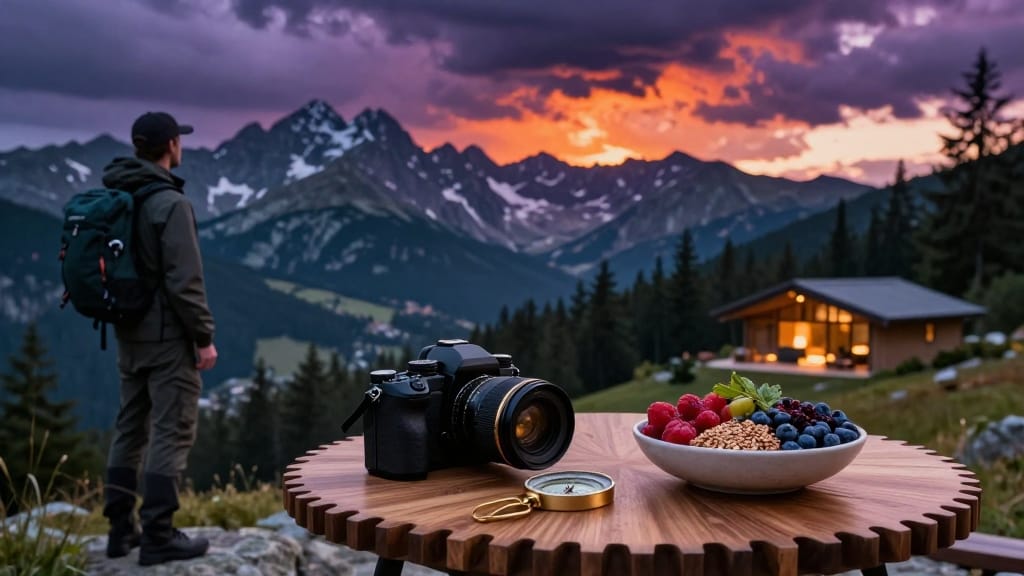
Cześć! If you’ve been staring at your passport lately and wondering if 2026 is finally the year to book that life-changing expedition, you aren’t alone—but the "vibes" are definitely shifting in a way we haven't seen since the world reopened. As someone who lives for a rugged mountain hike in the Tatras and the perfect golden-hour shot for my grid, I’ve noticed that traveling lately feels less like a breezy vacation and more like playing a high-stakes video game where the developers keep patching the rules in real-time. We are currently witnessing a massive surge in global wandering, yet it's wrapped in a thick, chilly layer of international apprehension that’s impossible to ignore. From erratic winter storms grounded in undeniable climate shifts to a total, "floor-is-lava" style reconfiguration of how we view healthy food and professional photography, the lifestyle landscape is shifting beneath our feet. For us in Poland and across the EU, this isn't just news—it's the reality of how we plan our weekends and our futures.
In this deep dive, I’m looking at how we move, eat, and capture our world in a year that I've dubbed the era of "micro-adventures and macro-stress." We are balancing a primal craving for the unknown with a very real, very adult need for flexibility. Whether it’s the logistical chaos of a North Texas blizzard or the high-tension trade wars making a hop across the Atlantic feel more like a political statement than a holiday, there’s a massive amount of meta-context to unpack. According to the New York Times, 2026 is officially the year of biometrics and uncertainty, where travelers are forced to become as agile as a pro gamer just to reach their destination. It’s no longer just about the destination; it’s about the "lag" we encounter along the way. Let's break down why our suitcases are getting smaller, our food is getting "upside-down," and why your old school photos are about to look like relics from the Stone Age.
The End of the "Globetrotter" Era? Politics, Fatigue, and the Greenland Gambit
There’s a weird, heavy energy in the air when even the most powerful people on the planet start catching "flight fatigue." You know that feeling when you've been on a bus for eight hours and you just want to delete the world? It seems world leaders are feeling it too. As reported by The Daily Beast, President Trump, now 79, is reportedly moving away from international travel in favor of touring the U.S. domestic circuit after a particularly "hellish" flight experience. This isn't just a celebrity gossip point; it mirrors a broader 2026 trend where "microvacations"—shorter, local trips that don't involve crossing six time zones—are replacing the long-haul exhaustion we used to chase. As a Pole, I totally get this; sometimes a weekend trip to Zakopane or a quick train ride to Berlin is infinitely more refreshing than a 15-hour flight that leaves you looking like a zombie in your own photography. We are seeing a "localization" of adventure, where the quality of the experience is measured by the lack of stress rather than the number of stamps in a passport.
But it’s not just personal preference or age; it’s the geopolitics of where we go that’s making things "spicy" (and not the good, Szechuan kind of spicy). Right now, the relationship between Europe and the U.S. feels like a multiplayer lobby where everyone has their mics muted and is just spamming emotes. Yahoo Finance reports that Trump recently called off tariffs on Europe regarding the Greenland dispute, but only after reaching a "framework" deal that still feels incredibly fragile. This follows days where even European populist leaders, usually staunch allies of the MAGA movement, broke ranks over the Greenland issue, as noted by The Washington Post. For us Europeans, it feels like our continent and its territories are being treated like assets in a game of Risk. When the CNBC notes that EU lawmakers suspended a trade deal because of tariff threats, it sends a ripple effect through the travel industry. If trade is stalled, flights get more expensive, and the cultural exchange that travel represents starts to wither. The New York Times highlights that Europe is currently frantically looking for ways to project strength and unity to an administration that views the EU as a fragmented entity.
The stakes are even higher when you consider the security of our borders. President Zelenskyy has been vocal at events like Davos, as reported by CNBC, criticizing Europe for being "lost" and trying too hard to appease others instead of dealing with the existential global threats on our doorstep. As someone living in Poland, this hits differently. When he talks about the need for a strong, unified European defense against Russian aggression and the ongoing war in Ukraine, it’s not just a news segment—it’s about the safety of our hiking trails and the stability of our homes. Travel isn't just about the scenery anymore; it’s about the "leverage" and "vulnerability" of the places we visit. Every time I cross a border now, I’m more aware of the political gravity holding the gate open.
Winter Storm Fern and the Logistics of Digital-Age Survival
If you've ever been stuck at an airport during a snowstorm with nothing but a 10 PLN chocolate bar and a dying phone battery, you know that Mother Nature is the ultimate "final boss." Right now, North Texas is facing exactly that. Winter Storm Fern is descending, and as KERA News reports, hundreds of travel plans are already being decimated. But here is where the "video game update" vibe comes back in: the response from airlines is actually becoming more pro-consumer, which is a rare sentence to write. According to The Dallas Morning News, American Airlines has issued proactive travel alerts, allowing passengers to rebook before the first snowflake hits the ground. This shift toward "radical flexibility" is the industry's way of dealing with a climate that has become increasingly unpredictable.
This "no-cost" movement is quickly becoming the 2026 gold standard for traveler loyalty. Spectrum Local News confirms that Delta, Southwest, and United are joining the fee-waiving party. It’s a smart move—if you can’t control the weather, you can at least control the customer’s blood pressure. But survival isn't just for those in the air. For those hunkering down, WCVB suggests having a specific, non-perishable plan for food and water. This "prepper-lite" lifestyle is bleeding into how we travel; more people are carrying high-capacity power banks and satellite-enabled phones even for "casual" hiking. Preparation is the new "carefree."
However, the social climate is getting as cold as the weather. In a bizarre turn of events, Fox News reports that in Minnesota, federal agents were reportedly stalked and pelted with food and spit at gas stations. This highlights a growing tension in how we interact in public spaces. As travelers, we are no longer neutral observers; we are moving through a world where even a stop at a gas station can become a flashpoint for social unrest. It makes me appreciate the relative calm of a forest trail in Poland, but it's a stark reminder that the "safety" we once took for granted in Western travel is being replaced by a need for constant situational awareness. It’s sarcasm and meme-worthy until you’re the one caught in the middle of a polarization storm.
Rethinking the "Life" in Lifestyle: Nutrition and the Food Pyramid DLC
As a foodie who will literally travel three hours for the perfect pierogi or a authentic poke bowl, I find the current "diet wars" absolutely fascinating. Remember that food pyramid we were shown in school? The one that looked like a basic tutorial level? Well, the government just released a "DLC" update, and the reviews are mixed. According to Food & Wine, dietitians are split on the new Dietary Guidelines for Americans. While the focus has shifted toward whole foods—which I love—the new "upside-down" pyramid is proving to be super confusing for the average person. It’s like when a game developer updates the UI and suddenly you can't find your inventory. Are we supposed to eat more protein or just look at it? The lack of clarity is creating a vacuum that "wellness influencers" are all too happy to fill with questionable advice.
If you're worried about your health while on the road, the advice is getting more "back to basics" and less "superfood of the month." Parade recently spoke with cardiologists about the "worst food" for artery health, and to no one's surprise, it’s the highly processed, fried "gas station gourmet" we often rely on during road trips. For a traveler, this is the ultimate challenge: how do you find fuel for your body that won't give you a "debuff" for the rest of the day? The 2026 trend is moving toward "travel meal-prepping," where people are more likely to bring their own high-protein snacks than risk a cardboard-tasting sandwich at a terminal. It’s about taking control of your personal "stats" in a world of low-quality options.
But it's not all about "self-optimization." Food is also becoming a way for communities to bond during these tough economic times, which honestly restores some of my faith in humanity. For example, students at the Cavalier Food Pantry are hosting a "SouperBowl of Caring" to help classmates combat food insecurity, as reported by CBS19 News. This is the "wholesome content" we need. In a year defined by trade wars and tariffs, the act of sharing a meal becomes a quiet, powerful form of rebellion against the chaos. Whether it’s a shared table in a hostel or a community food drive, the "lifestyle" part of travel is increasingly about the people you share a plate with, rather than just the food itself. It’s a vibe check that proves we are still human, even in an increasingly digital world.
Photography’s New Edge: From School Portraits to Celebrity Redemption
Being a total photography nerd who refuses to leave the house without at least two different lenses, I’m obsessed with how technology is changing our visual history. It’s not just about slapping an "Aesthetic" filter on your sunset shots anymore; it’s about the raw power of the hardware. PR Newswire recently reported that CADY, a giant in the school photography world, is exclusively switching to Sony Electronics’ imaging technology. This is actually huge. It means the next generation of kids might actually have school photos that don't look like they were taken with a literal potato. We’re talking about high-dynamic-range imaging and professional-grade sensors being used for something as "everyday" as a yearbook photo. It’s a testament to how 2026 is the year where "prosumer" tech becomes the baseline.
This "professionalization" of our daily lives extends into the digital economy too. For digital nomads and real estate moguls alike, how a space is photographed determines its entire value. Services like Time Off Editing are highlighting that in a saturated market, high-end real estate photo editing isn't a luxury—it's survival. If your Airbnb or rental doesn't look like a Wes Anderson set, do you even exist in the algorithm? We are living in a visual-first economy where "pixel-perfect" is the minimum requirement for engagement. As someone who spends hours editing the blue out of my snowboarding shots, I feel this in my soul. Every photo we take is a piece of currency in the "attention economy."
Then, of course, there’s the bizarre world of celebrity photography, which is its own kind of "meme lore." Remember Brooklyn Beckham’s photography book, What I See? When it dropped in 2017, it was mocked into oblivion—the "elephants in shadows" shot is legendary for all the wrong reasons. But in 2026, it’s having a bizarre "redemption arc." The Daily Mail reports that copies are now selling for almost £300. Why? Because of the drama surrounding a family feud. AOL calls it an "unlikely surge," likely fueled by the spectacle. Yet, despite the cringe, the book contains some genuinely sweet moments where Beckham praises his parents as his "heroes," as noted by another Daily Mail report. It just proves that in our world, "bad" art plus "good" drama equals a valuable asset. It’s basically the NFT logic of the physical book world. Whether we’re using Sony’s latest tech or a celebrity’s controversial lens, we are all just trying to capture a version of "truth" that sells.
Conclusion: The Future is Local, High-Definition, and Resilient
So, what’s the final "boss battle" verdict for 2026? Whether we’re navigating a blizzard in Texas, debating the merits of an upside-down food pyramid, or checking the latest trade news from Brussels, the trend is crystal clear: we are moving toward a more localized, flexible, and tech-driven way of living. We’re trading "hellish" 15-hour international flights for high-quality "microvacations" that allow us to actually rest. We’re questioning the old nutritional "pyramids" that don't fit our modern lives and replacing them with a more nuanced, whole-food-first mindset that prioritizes long-term health over convenience. And we’re using significantly better technology to document it all, ensuring that our personal histories are captured with a level of clarity that was previously reserved for the elite.
The future of travel and lifestyle isn't just about the "where"—it's about the "how." How do we adapt when the weather changes? How do we stay connected when trade deals fall apart? How do we project strength as a unified European community in the face of global uncertainty and the ongoing threats surrounding Ukraine and our eastern borders? We do it by being prepared, being empathetic, and—honestly—having a sense of humor about the chaos. So pack your bags (maybe just a carry-on this time), grab your Sony, and keep those airline alerts turned on. And hey, if you happen to find a copy of that Beckham book in a dusty thrift store in Kraków for 5 PLN, buy it immediately. It might just fund your next snowboarding trip to the Alps! Stay adventurous, stay skeptical, and always keep your batteries charged. Do zobaczenia on the road!